






Correct option is B
Correct Answer:
✅
(b) Bacteria
Explanation:
Nosocomial infections (also called
hospital-acquired infections - HAIs) are
infections that develop during hospitalization or medical care. These infections occur
48 hours or more after hospital admission and are caused by various
microbes, primarily bacteria.
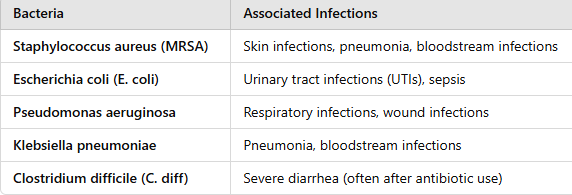
Common Bacteria Causing Nosocomial Infections:
Common Types of Nosocomial Infections:
✅ Urinary Tract Infections (UTIs) → Often caused by E. coli, linked to catheter use. ✅ Surgical Site Infections (SSIs) → Wound infections after surgery, often caused by Staphylococcus aureus. ✅ Pneumonia → Ventilator-associated pneumonia (VAP), caused by Pseudomonas aeruginosa. ✅ Bloodstream Infections (Sepsis) → Related to IV catheters and central lines.
Why Other Options Are Incorrect?
❌ (a) Fungi
·
Fungal infections (like Candida albicans) can cause hospital-acquired infections, but bacteria are the primary cause.
·
Fungal infections are less common than bacterial infections in hospitals.
❌ (c) Blue-green algae
·
Blue-green algae (cyanobacteria) do not cause nosocomial infections.
·
They are found in water bodies, not in hospital environments.
❌ (d) Virus
·
Viruses can cause nosocomial infections (e.g., COVID-19, Influenza, Hepatitis B), but bacteria are the most frequent cause.
·
Bacterial infections are harder to control in hospital settings due to antibiotic resistance.
Prevention of Nosocomial Infections:
✅ Hand Hygiene → Regular handwashing with alcohol-based sanitizers. ✅ Sterilization of Medical Equipment → Disinfecting surgical tools, catheters, and ventilators. ✅ Antibiotic Stewardship → Preventing overuse of antibiotics to reduce resistance. ✅ Isolation of Infected Patients → Preventing the spread of multi-drug-resistant bacteria.
 English
 100 Questions
 100 Marks
 90 Mins


