






Correct option is D
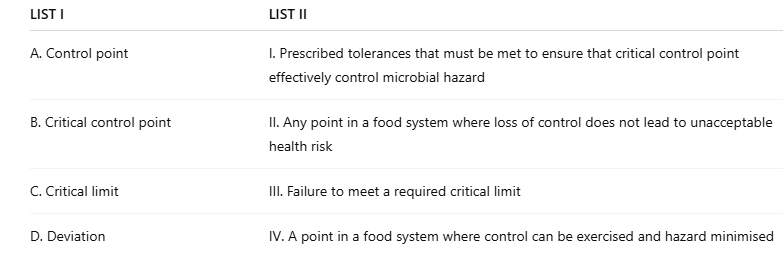
Control point (A) refers to any step in a food production process where control can be applied to prevent or reduce a hazard, but losing control at this point may not necessarily result in an unacceptable health risk. This means it's a point where control is desirable but not always critical. Hence, it matches with
II: Any point in a food system where loss of control does not lead to unacceptable health risk.
Critical control point (B) is a specific step at which control must be applied to prevent, eliminate, or reduce a food safety hazard to an acceptable level. At this point, failure to control could directly lead to a health risk. This corresponds to
IV: A point in a food system where control can be exercised and hazard minimised.
Critical limit (C) represents the maximum or minimum value to which a biological, chemical, or physical parameter must be controlled at a critical control point to prevent, eliminate, or reduce hazards. It is the precise tolerance or standard that must be met. This fits
I: Prescribed tolerances that must be met to ensure that critical control point effectively control microbial hazard.
Deviation (D) refers to any failure to meet a critical limit at a critical control point. When a deviation occurs, it signals that a process is out of control and requires corrective actions. This matches
III: Failure to meet a required critical limit.
Information Booster
In the context of food safety and quality assurance systems like HACCP (Hazard Analysis and Critical Control Points), understanding these terms ensures that food producers can systematically identify and manage risks.
·
Control points allow monitoring but are not necessarily points where immediate corrective action is required if control is lost.
·
Critical control points are vital steps in production where controls are mandatory to ensure safety.
·
Critical limits provide measurable criteria (such as temperature or pH) that define the boundary between safe and unsafe food.
·
Deviation is a warning sign that the process is no longer safe and corrective action must be taken to avoid contamination or hazards.
 English
 10 Questions
 20 Marks
 12 Mins


