






Correct option is A
Introduction:
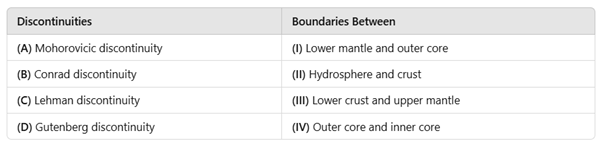
- Mohorovicic discontinuity (a) is found between the lower crust and upper mantle (iii), marking the boundary where seismic waves change due to different densities and compositions.
- Conrad discontinuity (b) is located between the hydrosphere and crust (ii), representing the boundary at which the characteristics of the Earth's crust change, often related to geological formations.
- Lehman discontinuity (c) is associated with the outer core and inner core (iv), indicating a transition point where the materials change from liquid to solid.
- Gutenberg discontinuity (d) is identified at the boundary of the lower mantle and outer core (i), indicating the transition from the liquid outer core to the solid inner core.
Information Booster:
- Mohorovicic Discontinuity: This layer is crucial for understanding the Earth's structure as it separates the crust from the mantle, revealing insights into seismic activity.
- Conrad Discontinuity: Important for geological mapping, this discontinuity helps in locating mineral deposits and understanding tectonic plate interactions.
- Lehman Discontinuity: Understanding this boundary aids in geophysical studies, particularly regarding Earth's magnetic field and composition.
- Gutenberg Discontinuity: This transition is significant for understanding the inner workings of the Earth’s core, impacting theories related to Earth's geothermal dynamics.
Additional Information:
- The Mohorovicic discontinuity is often referred to as the Moho and is a fundamental concept in geology, indicating a change from less dense rocks to denser mantle materials.
- The Conrad discontinuity is less well-defined compared to the Moho but is essential for understanding variations in crustal composition.
- The Lehman discontinuity reflects the complexities of the core's physical state, providing evidence for the Earth's formation and evolution.
- The Gutenberg discontinuity plays a crucial role in the understanding of seismic waves and their behaviors as they pass through different materials.
 English
 10 Questions
 20 Marks
 12 Mins


