






 Code -
Correct option is A
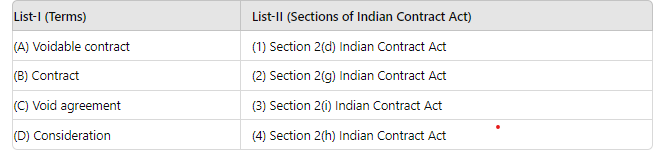
(A) Voidable contract - Section 2(i) Indian Contract Act: Section 2(i) defines a voidable contract as an agreement that is enforceable by law at the option of one or more of the parties but not at the option of the other or others.
· (B) Contract - Section 2(h) Indian Contract Act: Section 2(h) defines a contract as an agreement enforceable by law.
· (C) Void agreement - Section 2(g) Indian Contract Act: Section 2(g) defines a void agreement as one that is not enforceable by law.
· (D) Consideration - Section 2(d) Indian Contract Act: Section 2(d) defines consideration as something in return for a promise, which can be an act, forbearance, or a promise.
Information Booster:
1. Section 2(d) Indian Contract Act: This section explains the concept of consideration, which is an essential element for a valid contract.
2. Section 2(g) Indian Contract Act: It defines a void agreement, which has no legal effect and cannot be enforced.
3. Section 2(h) Indian Contract Act: It defines a contract as an agreement that creates legal obligations and is enforceable by law.
4. Section 2(i) Indian Contract Act: It explains a voidable contract, where one party has the option to either affirm or rescind the contract due to certain circumstances like misrepresentation or coercion.
Additional Information:
· Voidable Contract (Section 2(i)): A contract that is valid until the aggrieved party chooses to void it.
· Contract (Section 2(h)): An agreement that is legally binding and enforceable by law.
· Void Agreement (Section 2(g)): An agreement that lacks enforceability and thus holds no legal effect.
· Consideration (Section 2(d)): The price paid by one party for the promise of the other, a key requirement for a contract to be valid.


