






Correct option is D
Introduction
Glaciers are large, persistent bodies of ice that play a crucial role in the Himalayan ecosystem and water resources.
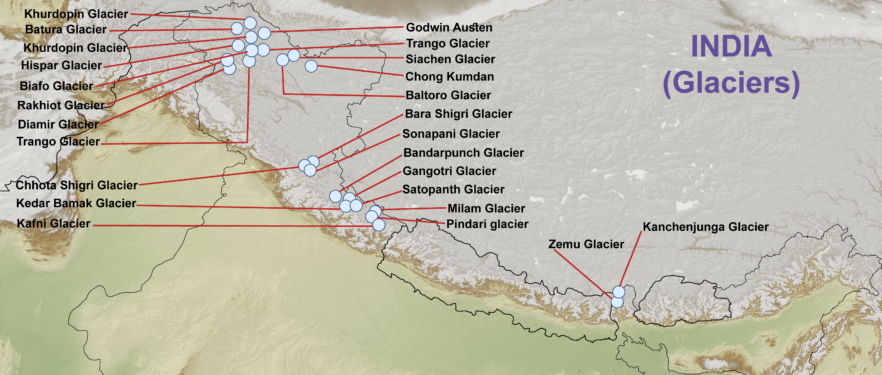
These glaciers are distributed across the major ranges of the Himalayas and Karakoram.
The correct match is A-I, B-II, C-III, D-IV.
Information Booster
- Siachen
- The Siachen Glacier is the largest glacier in the Karakoram Range and the longest in the world's non-polar areas.
- It is located in the eastern Karakoram, a sub-range of the Himalayas, and is a major geopolitical point between India and Pakistan.
- Sonapani
- The Sonapani Glacier is located in the Chandra river basin of the Lahaul valley, a part of the Pir Panjal Range (Lesser Himalayas), predominantly in the state of Himachal Pradesh.
- The Pir Panjal Range forms the largest range of the Lesser Himalayas and runs through Himachal Pradesh and the Union Territory of Jammu and Kashmir.
- Rongbuk
- The Rongbuk Glacier is located in the Himalayas of Southern Tibet (China), at the northern foot of Mount Everest.
- Mount Everest and the entire Khangchendzonga-Everest massif (Kanchenjunga-Everest Region) are part of the Great Himalayas, making this the correct regional association in the context of the options.
- Mana
- The Mana Glacier is associated with the Mana Peak and Mana Pass, and is located in the Garhwal Himalayas, within the Kumaon-Garhwal Region of Uttarakhand.
- This region is famous for many glaciers that feed the Ganges river system, such as Gangotri and Milam.
Additional Knowledge
- The Karakoram Range is geographically distinct from the main Himalayan ranges but is often included in the greater Himalayan system. It hosts the world’s highest concentration of high peaks outside the poles.
- The Kumaon-Garhwal Region (Uttarakhand) contains the sources of major rivers like the Ganga (via Bhagirathi and Alaknanda) and the Yamuna.
- Glacier melt in the Himalayas is a major concern for the water security of South Asia, as these glaciers are often called the "Third Pole".
 English
 10 Questions
 20 Marks
 12 Mins


