Correct option is A
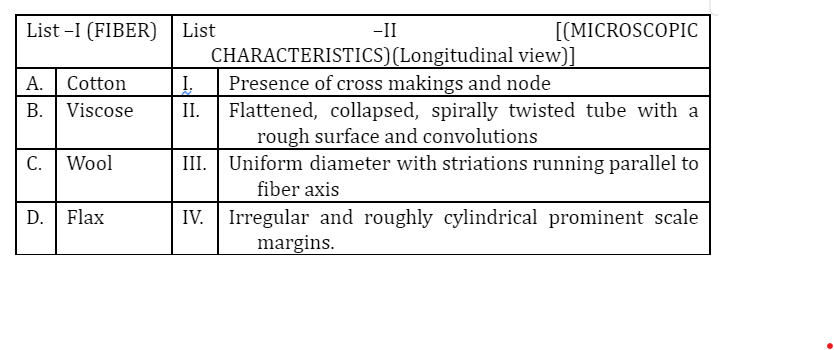
A. Cotton → II. Flattened, collapsed, spirally twisted tube with a rough surface and convolutions
Cotton fibers, when viewed under a microscope in longitudinal form, exhibit distinct characteristics. These include:
·
Flattened and collapsed shape: Cotton fibers do not have a perfectly cylindrical structure but appear somewhat flattened or collapsed.
·
Spirally twisted tube: Cotton naturally twists upon itself, forming what is known as convolutions. These twists are a distinguishing feature of cotton fibers.
·
Rough surface: The surface of the cotton fiber is not smooth; it has a natural texture with convolutions. This structural feature helps cotton fibers trap air, making the fabric breathable and moisture absorbent. This is why cotton is widely used for clothing, especially in warm climates.
B. Viscose → III. Uniform diameter with striations running parallel to fiber axis
Viscose (also known as rayon) is a man-made fiber, regenerated from cellulose. Under microscopic examination:
·
Uniform diameter: Viscose fibers appear cylindrical, with an even and consistent diameter throughout their length.
·
Striations running parallel: These fibers have fine lines (striations) running along the length of the fiber, parallel to the axis. These lines are formed during the production process and give the fiber its unique appearance. Viscose is known for its
silk-like luster and is commonly used in garments due to its smooth texture, drape, and breathability. The uniformity of the fibers contributes to its softness and high-quality finish.
C. Wool → IV. Irregular and roughly cylindrical prominent scale margins
Wool fibers, when observed under a microscope, display the following key characteristics:
·
Irregular and cylindrical: Wool fibers do not have a smooth surface. Instead, they appear rough and cylindrical.
·
Prominent scale margins: One of the defining characteristics of wool fibers is the presence of overlapping scales on the fiber surface. These scales are what give wool its texture and contribute to its ability to felt and trap air. Wool's scaly structure makes it excellent for retaining warmth, as the scales lock together and trap air pockets. This also contributes to its durability and water-repellent properties, making wool ideal for cold-weather clothing.
D. Flax → I. Presence of cross markings and node
Flax fibers, used to make linen, have a distinct appearance under a microscope:
·
Cross markings: These fibers have visible horizontal cross lines or markings. These are characteristic of bast fibers like flax.
·
Nodes (or joints): Flax fibers also exhibit joints or nodes, which give them a bamboo-like appearance when viewed longitudinally. Flax fibers are
strong and durable, which makes linen highly valued for its toughness and smoothness. These nodes and cross markings contribute to the unique texture and crisp feel of linen fabrics.
1. Cotton:
·
Microscopic Appearance: Cotton fibers have a
flattened, twisted structure with convolutions. This makes cotton very absorbent and breathable.
·
Properties: Cotton is soft, comfortable, and ideal for use in warm weather due to its ability to wick moisture.
·
Applications: Cotton is used widely in
clothing,
bedding,
towels, and other textiles because of its softness, breathability, and durability.
2. Viscose:
·
Microscopic Appearance: Viscose fibers are
smooth and uniform with parallel striations. This uniformity gives the fabric a high sheen and smooth finish.
·
Properties: Viscose is often referred to as a "semi-synthetic" fiber because it is derived from natural cellulose but goes through a chemical process. It has a silk-like feel and is soft, breathable, and absorbent.
·
Applications: Viscose is used in
draperies,
clothing,
upholstery fabrics, and
linings due to its luxurious feel and sheen.
3. Wool:
·
Microscopic Appearance: Wool fibers are
irregular with
overlapping scales, which gives the fiber its rough texture and ability to felt. These scales are visible under a microscope and are one of wool’s defining characteristics.
·
Properties: Wool is
insulating,
water-resistant, and
elastic, making it perfect for cold climates. Its ability to trap air provides warmth.
·
Applications: Wool is commonly used in
sweaters,
coats,
suits,
carpets, and other items where warmth, durability, and comfort are needed.
4. Flax (Linen):
·
Microscopic Appearance: Flax fibers show
cross markings and nodes along their length, resembling bamboo.
·
Properties: Linen (fabric made from flax) is
strong,
durable, and has a natural luster. It is known for being cool and comfortable in warm weather.
·
Applications: Linen is used in
summer clothing,
tablecloths,
bedding, and
home furnishings. It is valued for its strength and breathability.
Information Booster:
·
Cotton convolutions create the fluffy, soft texture that makes cotton breathable and comfortable for everyday wear. Its ability to absorb moisture makes it highly popular in hot, humid climates.
·
Viscose is smooth and soft, mimicking silk in appearance. It is highly absorbent, making it suitable for summer garments. Its smooth surface gives it a luxurious feel, often used in high-end fashion and interior decor.
·
Wool fibers have a natural crimp, which, combined with the scaly structure, allows wool to trap heat, providing insulation. This makes wool ideal for winter garments and cold-weather accessories.
·
Flax has a crisp, smooth feel, and its nodes contribute to the cool texture of linen fabric. Linen is known for its durability, making it a long-lasting fabric often passed down as heirloom tablecloths or bedding.
 English
 10 Questions
 20 Marks
 12 Mins