






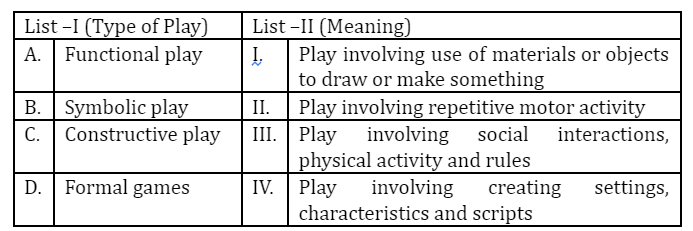
Correct option is B
·
Functional play (A) involves
repetitive motor activity (II). This is the simplest form of play, where children engage in activities like pushing a toy back and forth or stacking blocks.
·
Symbolic play (B) involves
creating settings, characteristics, and scripts (IV). Children engage in make-believe or pretend play, using objects to represent other things or creating stories.
·
Constructive play (C) involves
using materials or objects to create or make something (I). This type of play includes activities like building a tower from blocks or crafting a model.
·
Formal games (D) involve
social interaction, physical activity, and rules (III). These structured activities include board games, card games, or sports, where rules and interaction are key components.
Information Booster:
·
Functional Play: This type of play is common in infants and toddlers, where they use basic actions like squeezing, shaking, or moving objects to understand the physical world around them.
·
Symbolic Play: Also known as
imaginative play, symbolic play allows children to engage in pretend scenarios, developing their creativity, language skills, and understanding of roles in society.
·
Constructive Play: Involves
creating something with physical materials like blocks, clay, or drawing tools. It helps develop motor skills, planning, and cognitive abilities as children experiment with different materials to bring their ideas to life.
·
Formal Games: These are games that have
rules and often involve multiple players, requiring social interaction. This type of play promotes cooperation, understanding of rules, and the development of strategic thinking.
 English
 10 Questions
 20 Marks
 12 Mins


