






Correct option is B
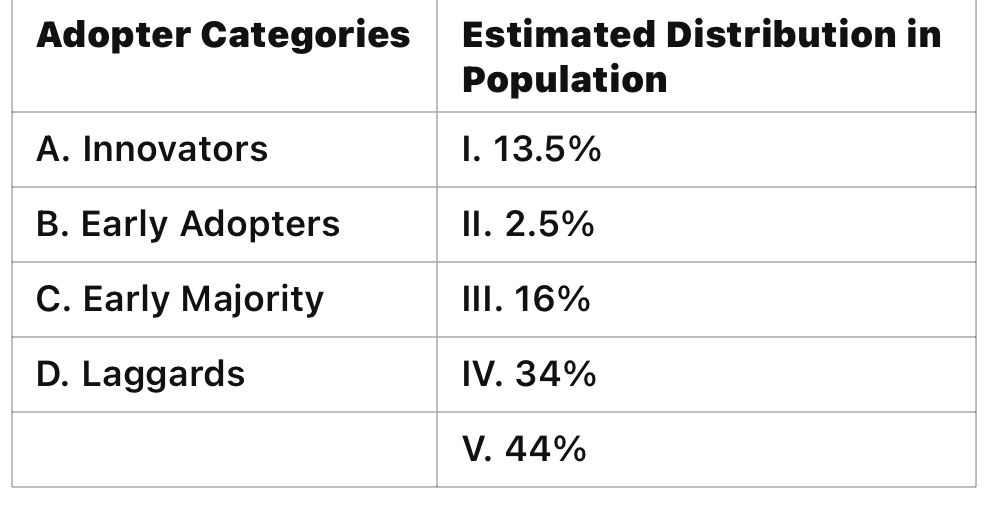
The Diffusion of Innovation Theory by Everett Rogers explains how new ideas, products, or technologies spread through a population over time. The theory categorizes adopters into five groups based on their willingness to adopt innovations, each with a specific estimated percentage of the population.
The correct matching of Adopter Categories with their Estimated Distribution in Population is:
· Innovators (A) - 2.5% (II)
· The first individuals to adopt a new innovation.
· They are risk-takers, open to new ideas, and financially capable of experimentation.
· Early Adopters (B) - 13.5% (I)
· Opinion leaders who adopt innovations early but carefully.
· They help spread the innovation to the majority.
· Early Majority (C) - 34% (IV)
· Adopt an innovation after seeing evidence of its success.
· More cautious than early adopters but influential in mass adoption.
· Laggards (D) - 16% (III)
· The last group to adopt an innovation, often resistant to change.
· Prefer traditional ways and adopt only when necessary.
Thus, the correct answer is: (b) A-II, B-I, C-IV, D-III.
Information Booster:
Diffusion of Innovation Model - Five Adopter Categories:
1. Innovators (2.5%) – Risk-takers, financially stable, love trying new technologies.
2. Early Adopters (13.5%) – Influencers, opinion leaders, early trendsetters.
3. Early Majority (34%) – More cautious but adopt once they see benefits.
4. Late Majority (34%) – Skeptical, adopt due to peer pressure or necessity.
5. Laggards (16%) – Traditionalists, resist change until forced to adopt
Importance of the Theory:
· Helps marketers and policymakers understand how to promote new technologies.
· Explains why some people adopt changes faster than others.
 English
 10 Questions
 20 Marks
 12 Mins


