Correct option is D
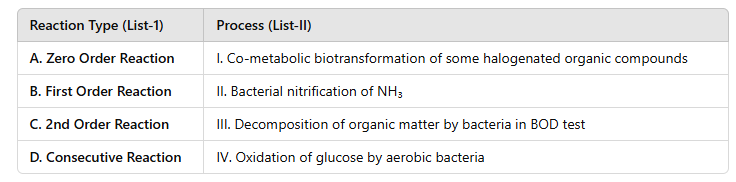
1. Zero Order Reaction (A-IV):
· In a zero-order reaction, the reaction rate is independent of the concentration of the reactant. The oxidation of glucose by aerobic bacteria can proceed at a constant rate due to the enzymatic control.
2. First Order Reaction (B-III):
· In a first-order reaction, the reaction rate depends on the concentration of one reactant. The decomposition of organic matter by bacteria in the BOD test follows first-order kinetics.
3. Second Order Reaction (C-II):
· In a second-order reaction, the rate depends on the concentrations of two reactants. Bacterial nitrification of ammonia (NH₃) involves reactions that fit second-order kinetics.
4. Consecutive Reaction (D-I):
· In consecutive reactions, intermediates form and transform into the final products. Co-metabolic biotransformation of halogenated organic compounds often involves consecutive steps.
Information Booster:
1. Zero Order Reaction:
· Rate = k (constant), independent of reactant concentration.
· Example: Enzymatic reactions at saturation.
2. First Order Reaction:
· Rate = k[A], depends on one reactant.
· Example: Radioactive decay, BOD decomposition.
3. Second Order Reaction:
· Rate = k[A][B] or k[A]², depends on two reactants or squared concentration of one.
· Example: Nitrification reactions.
4. Consecutive Reaction:
· Multi-step reaction sequence where intermediates form.
· Example: Biotransformation of complex pollutants.
Additional Knowledge:
1. (a) Zero Order Reaction:
· Occurs under enzyme-saturated conditions.
· Example: Breakdown of glucose in aerobic conditions.
2. (b) First Order Reaction:
· Reaction rate proportional to a single reactant.
· Example: BOD decomposition during wastewater treatment.
3. (c) Second Order Reaction:
· Involves two molecules or squared concentration.
· Example: Nitrification where ammonia reacts with oxygen.
4. (d) Consecutive Reaction:
· Involves intermediates, common in biological and chemical processes.
· Example: Co-metabolic biotransformation involving multiple steps.
Key Points:
1. Kinetics help in understanding environmental processes like BOD degradation, nitrification, and pollutant biotransformation.
2. Zero Order Reactions are rate-limited by enzymatic saturation.
3. Consecutive Reactions are common in complex pollutant degradation pathways.
4. Matching reactions to real-world processes helps in environmental monitoring.
 English
 10 Questions
 20 Marks
 12 Mins