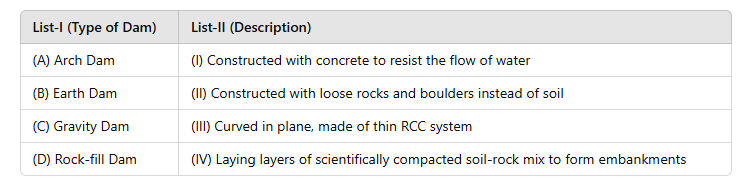
Correct option is B
Let’s revise the matching based on the correction:
1. (A) Arch Dam → (III):
· Arch dams are curved in plane and constructed of reinforced concrete (RCC). Their design helps distribute water pressure to the valley walls.
2. (B) Earth Dam → (II):
· Earth dams are constructed with loose rocks and boulders instead of soil, providing economical and flexible solutions for storing water.
3. (C) Gravity Dam → (I):
· Gravity dams are constructed with concrete and use their own weight to resist water pressure.
4. (D) Rock-fill Dam → (IV):
· Rock-fill dams involve laying layers of scientifically compacted soil-rock mix to form embankments that are strong and impermeable.
Thus, the correct matching is (A)-(III), (B)-(II), (C)-(I), (D)-(IV), making the correct answer Option 2.
Information Booster: 1. Arch Dam:
· Requires strong rock foundations.
· Example: Idukki Dam (India).
2. Earth Dam:
· Uses natural materials like soil and rocks.
· Example: Hirakud Dam (India).
3. Gravity Dam:
· Highly durable and long-lasting.
· Example: Bhakra Dam (India).
4. Rock-fill Dam:
· Combines impermeable cores with rocks for stability.
· Example: Tehri Dam (India).
Additional Knowledge: Design Suitability:
· Arch Dam: For narrow valleys with rocky terrain.
· Earth Dam: Suitable for areas with abundant soil resources.
· Gravity Dam: Needs wide and stable valleys.
· Rock-fill Dam: Ideal for regions with rocky materials.
Construction Efficiency:
· Arch Dam: Economical for narrow sites.
· Earth Dam: Cost-effective with local materials.
· Gravity Dam: Requires significant material volume.
· Rock-fill Dam: Flexible for varied terrains.
 English
 10 Questions
 20 Marks
 12 Mins