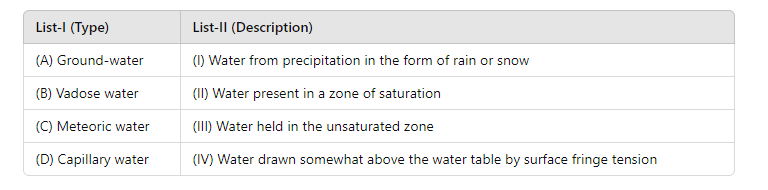
Correct option is B
Ground-water (A)-(II):
· Groundwater is located below the surface in the saturated zone, where all pore spaces are filled with water.
Vadose water (B)-(III):
· Vadose water exists above the groundwater in the unsaturated zone, where water coexists with air in soil pores.
Meteoric water (C)-(I):
· Meteoric water originates from atmospheric precipitation, such as rain or snow, and replenishes surface and subsurface water bodies.
Capillary water (D)-(IV):
· Capillary water is held by surface tension slightly above the water table and remains accessible to plants.
Information Booster: 1. Zones of Groundwater:
· Saturated Zone: Contains groundwater, located below the water table.
· Unsaturated Zone (Vadose): Lies above the water table and contains a mix of water and air.
2. Meteoric Water:
· Represents the major input of fresh water into hydrological cycles.
3. Capillary Action:
· Refers to the movement of water within porous materials due to adhesion and surface tension, supporting plant root water uptake.
4. Significance of Vadose Water:
· Important for soil moisture and nutrient availability.
5. Recharge of Groundwater:
· Meteoric water is a primary source of aquifer recharge.
Information Booster: 1. Electromagnetic Spectrum Order:
· From highest to lowest frequency: Gamma rays > X-rays > Ultraviolet > Visible light > Infrared > Microwaves > Radiowaves.
2. Applications of Each Radiation:
· Gamma Rays: Cancer treatment, radioactive decay monitoring.
· X-rays: Medical imaging, security scanners.
· Infrared: Thermal imaging, remote controls.
· Microwaves: Radar, cooking (microwave ovens).
· Radiowaves: TV, radio, and wireless communication.
3. Wavelength Relation:
· Frequency is inversely proportional to wavelength: Higher frequency = shorter wavelength.
4. Energy Hierarchy:
· Gamma rays and X-rays are ionizing, while infrared, microwaves, and radiowaves are non-ionizing.
5. Visible Light Placement:
· Falls between ultraviolet and infrared in the spectrum.
Additional Knowledge: · Gamma Rays (B):
· Wavelength: Less than 10 picometers.
· Produced by nuclear reactions and cosmic events.
· X-rays (D):
· Wavelength: 0.01–10 nanometers.
· Generated by electron transitions or deceleration in high-energy processes.
· Infrared Radiations (E):
· Wavelength: 700 nm to 1 mm.
· Used in thermal imaging and remote sensing.
· Microwaves (A):
· Wavelength: 1 mm to 1 meter.
· Key in radar technology and telecommunication.
· Radiowaves (C):
· Wavelength: 1 meter and above.
· Critical in radio and TV broadcasting.
 English
 10 Questions
 20 Marks
 12 Mins