






Correct option is B
1.
DES (Data Encryption Standard):
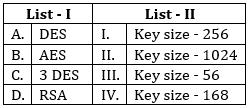
Matches with III. Key size = 56
DES is a symmetric-key algorithm for encryption with a
56-bit key size.
2.
AES (Advanced Encryption Standard):
Matches with I. Key size = 256
AES is widely used for secure data encryption and can support key sizes of
128, 192, and 256 bits.
3.
3 DES (Triple Data Encryption Standard):
Matches with IV. Key size = 168
3DES applies the DES algorithm three times to each data block, effectively creating a
168-bit key size.
4.
RSA (Rivest–Shamir–Adleman):
Matches with II. Key size = 1024
RSA is an asymmetric encryption technique typically using key sizes of
1024 bits or more.
Correct Answer:
(b) A-III, B-I, C-IV, D-II
Information Booster:
1.
DES (Data Encryption Standard):
· Developed by IBM in the 1970s.
· Utilizes a 56-bit symmetric key for encryption.
· Now considered insecure due to advances in computational power.
2.
AES (Advanced Encryption Standard):
· Established as a replacement for DES by the National Institute of Standards and Technology (NIST).
· Offers robust security for sensitive data and is widely used in government and private sectors.
3.
3 DES (Triple DES):
· Enhances DES security by encrypting data three times with three keys.
· Effective key size is 168 bits but slower compared to AES.
4.
RSA (Rivest–Shamir–Adleman):
· An asymmetric cryptographic algorithm using public and private keys.
· Primarily used for secure data transmission.
Additional Knowledge:
·
Key Size and Security:
· Larger key sizes provide stronger encryption but require more computational resources.
· AES is more efficient and secure compared to DES or 3DES.
·
Symmetric vs Asymmetric Encryption:
·
Symmetric Encryption: Same key for encryption and decryption (e.g., DES, AES).
·
Asymmetric Encryption: Uses a pair of public and private keys (e.g., RSA).
·
Modern Usage:
· DES is mostly obsolete.
· AES is the standard for modern encryption.
· RSA is popular for digital signatures and key exchange.
 English
 10 Questions
 20 Marks
 12 Mins


