






Correct option is A
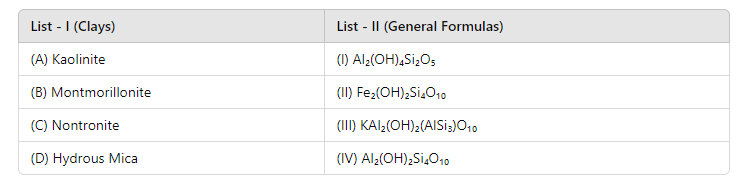
Kaolinite (A - I):
·
Formula: Al₂(OH)₄Si₂O₅.
· This is a common clay mineral that is a part of the 1:1 clay group, containing one tetrahedral and one octahedral sheet.
Montmorillonite (B - IV):
·
Formula: Al₂(OH)₂Si₄O₁₀.
· It is a swelling clay belonging to the smectite group, known for its high cation exchange capacity and water absorption.
Nontronite (C - II):
·
Formula: Fe₂(OH)₂Si₄O₁₀.
· Nontronite is an iron-rich clay mineral in the smectite group.
Hydrous Mica (D - III):
·
Formula: KAl₂(OH)₂(AlSi₃)O₁₀.
· Also known as illite, this clay contains potassium and is part of the mica group.
Information Booster: 1. Classification of Clays:
· Clays are classified based on their structure and composition, e.g., 1:1 and 2:1 layered silicates.
2. Uses of Clay Minerals:
· Kaolinite: Used in ceramics, paper, and cosmetics.
· Montmorillonite: Used in drilling mud, liners, and cat litter.
· Nontronite: Found in soils and is associated with iron-rich environments.
· Hydrous Mica: Found in sedimentary rocks and soil.
3. Chemical Properties:
· Clay minerals have varying cation exchange capacities, swelling properties, and thermal stability.
4. Environmental Significance:
· Clays play a role in soil fertility, pollutant adsorption, and water retention.
 English
 10 Questions
 20 Marks
 12 Mins


