






Correct option is D
Explanation:
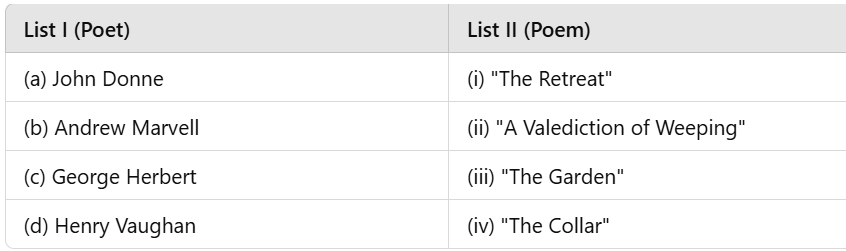
(a) John Donne → "A Valediction of Weeping"
A metaphysical poem by John Donne that explores themes of love, separation, and the intertwining of emotions.
(b) Andrew Marvell → "The Garden"
A pastoral poem reflecting on solitude, nature, and philosophical musings about the human condition.
(c) George Herbert → "The Collar"
A religious poem by Herbert, showcasing the speaker's struggle and eventual submission to God’s will.
(d) Henry Vaughan → "The Retreat"
A mystical poem about the soul’s journey and a longing for innocence and divine connection.
Information Booster:
Any poet in 17th-century England who tended toward the intellectual and personal depth and focus exhibited in the poetry of John Donne, the leading figure among the Metaphysicals, is considered a metaphysical poet. Others include Henry Vaughan, Andrew Marvell, John Cleveland, and Abraham Cowley as well as, to a lesser extent, George Herbert and Richard Crashaw.
Their work is a blend of emotion and intellectual ingenuity, marked by conceit or “wit”—that is, by the sometimes violent yoking together of apparently unconnected thoughts and things so that the reader is startled out of his complacency and compelled to think through the argument of the poem. Metaphysical poetry is less concerned with expressing feeling than with understanding it, with the poet investigating the caves of his consciousness.
John Donne (1572–1631):
A pioneer of metaphysical poetry. Known for his intellectual style, paradoxes, and conceits. Major themes: love, mortality, and spirituality. Uses metaphysical conceits to explore the depths of parting lovers’ emotions.
Andrew Marvell (1621–1678):
A metaphysical and Cavalier poet, celebrated for his wit and mastery of metaphors. Works reflect political allegory and nature. Reflects the harmony of nature and human introspection, presenting solitude as divine.
George Herbert (1593–1633):
A devotional poet known for simplicity and emotional resonance. His religious verse is deeply rooted in Christian faith. Expresses rebellion and acceptance, symbolizing the human struggle with faith.
Henry Vaughan (1621–1695):
A Welsh metaphysical poet, often called a mystical poet for his contemplative and spiritual writings. Focuses on nostalgia for the soul’s pre-existence and yearning for divine purity.
 English
 10 Questions
 20 Marks
 12 Mins


