






Correct option is B
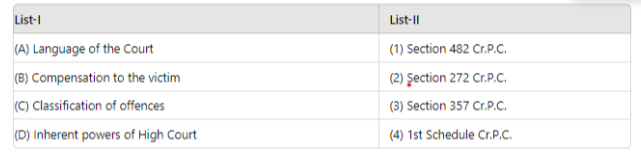
(A) Language of the Court - Section 272 Cr.P.C.: Section 272 of the Code of Criminal Procedure (Cr.P.C.) deals with the language to be used in the courts of the particular state, allowing each state government to determine the language.
· (B) Compensation to the victim - Section 357 Cr.P.C.: Section 357 of the Cr.P.C. empowers the court to order compensation to the victim, directing the payment of compensation out of the fines imposed on the accused, or even from other sources as ordered by the court.
· (C) Classification of offences - 1st Schedule Cr.P.C.: The 1st Schedule of the Cr.P.C. provides a classification of offences under the Indian Penal Code (IPC) and other laws, categorizing them based on their nature, such as bailable or non-bailable, cognizable or non-cognizable, and compoundable or non-compoundable.
· (D) Inherent powers of High Court - Section 482 Cr.P.C.: Section 482 of the Cr.P.C. outlines the inherent powers of the High Court to make such orders as may be necessary to prevent abuse of the process of any court or otherwise to secure the ends of justice.
Information Booster:
· Section 272 Cr.P.C.: This section gives authority to the state government to declare the official language in which the court proceedings should be conducted within its jurisdiction. This ensures that legal processes are accessible to the local population.
· Section 357 Cr.P.C.: Section 357 is vital in ensuring justice for victims of crime. It allows the court to order compensation to be paid to the victim for the loss or injury caused by the offence, ensuring that justice is not only punitive but also restorative.
· 1st Schedule Cr.P.C.: The 1st Schedule is crucial in the administration of criminal justice as it classifies offences to guide the procedure for trial, including whether the offence is bailable, cognizable, and the appropriate court for trial.
· Section 482 Cr.P.C.: This section grants inherent powers to the High Court to intervene in criminal proceedings to prevent the misuse of legal procedures or to ensure justice is served. It acts as a safety net for judicial processes.
Additional Knowledge:
· Language of the Court (Section 272 Cr.P.C.): Different states may have different official languages, and Section 272 allows for flexibility in court proceedings by adapting to the linguistic needs of each state.
· Compensation to the Victim (Section 357 Cr.P.C.): This section is part of the broader criminal justice framework that recognizes the rights of victims. The compensation may cover medical expenses, loss of earnings, and other impacts of the crime.
· Classification of Offences (1st Schedule Cr.P.C.): The classification provided in the 1st Schedule is essential for determining the procedure that follows when an offence is reported, including the arrest procedure, trial process, and bail provisions.
· Inherent Powers of High Court (Section 482 Cr.P.C.): The inherent powers under Section 482 allow the High Court to act in situations where the law is silent or insufficient, providing a mechanism to prevent the miscarriage of justice and maintain the integrity of the judicial process.


