






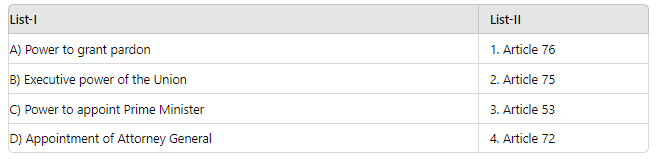
 Codes:
Correct option is B
A) Power to grant pardon - Article 72: This article grants the President of India the power to pardon, commute, or remit sentences in certain cases.
·
B) Executive power of the Union - Article 53: Article 53 vests the executive power of the Union in the President, to be exercised either directly or through officers subordinate to him.
·
C) Power to appoint Prime Minister - Article 75: This article provides the President with the power to appoint the Prime Minister of India and other ministers.
·
D) Appointment of Attorney General - Article 76: Article 76 outlines the appointment and duties of the Attorney General for India, who is the chief legal advisor to the Government of India.
Information Booster:
1.
Article 72: Allows the President to grant pardons, reprieves, respites, or remissions of punishment or to suspend, remit, or commute the sentence of any person convicted of any offense.
2.
Article 53: Vests all the executive powers of the Union in the President, who can exercise them either directly or through officers subordinate to him.
3.
Article 75: States that the Prime Minister is appointed by the President, and the other ministers are appointed by the President on the advice of the Prime Minister.
4.
Article 76: Refers to the appointment of the Attorney General for India, who is appointed by the President and holds office during the pleasure of the President.
Additional Information:
·
Pardoning Power: The President’s pardoning power is exercised on the advice of the Council of Ministers.
·
Executive Power: The President acts as the ceremonial head of the state, while real executive power is exercised by the Prime Minister and the Council of Ministers.
·
Prime Minister's Appointment: The President must appoint the leader of the majority party in the Lok Sabha as Prime Minister.
·
Attorney General: The Attorney General advises the government on legal matters and represents the government in the Supreme Court and other courts.


