Correct option is A
Explanation:
Cation Exchange Capacity (CEC) is a measure of how well soil can retain and supply cations (e.g., Ca²⁺, Mg²⁺, K⁺). It is influenced by clay content, organic matter, and mineral type.
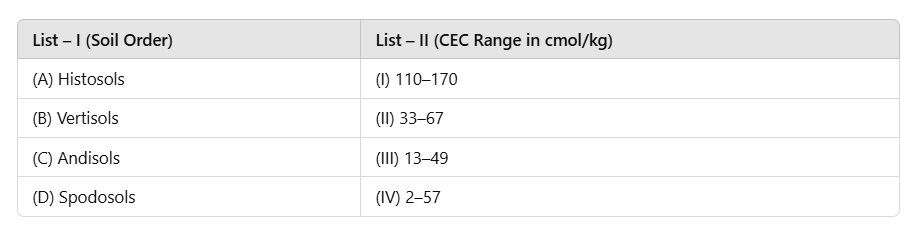
Matching each soil order with its typical CEC range:
· (A) Histosols → (I) 110–170 cmol/kg
· Organic soils (peat, muck); very high organic matter = very high CEC.
· (B) Vertisols → (II) 33–67 cmol/kg
· Rich in smectite clay minerals; high shrink-swell; moderately high CEC.
· (C) Andisols → (III) 13–49 cmol/kg
· Volcanic ash soils; moderate CEC due to allophane and imogolite minerals.
· (D) Spodosols → (IV) 2–57 cmol/kg
· Sandy, acidic soils with low clay content; low to moderate CEC.
Additional Information:
· CEC affects soil fertility, nutrient retention, and pH buffering.
· Soils with higher CEC are generally more fertile and better for agriculture.
 English
 10 Questions
 20 Marks
 12 Mins