






Correct option is C
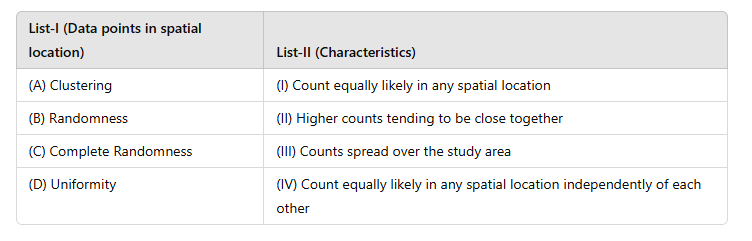
1. Clustering (A) → (IV):
· Clustering occurs when data points are grouped together, and the count is more likely in any spatial location, influenced by nearby points.
2. Randomness (B) → (III):
· Randomness implies that data points are spread across the study area without a discernible pattern but not necessarily independent of each other.
3. Complete Randomness (C) → (II):
· Complete randomness represents a condition where higher counts occur close together without any correlation to external factors.
4. Uniformity (D) → (I):
· Uniformity reflects a situation where data points are distributed evenly, making the count equally likely in all locations.
Thus, the correct match is (A)-(IV), (B)-(III), (C)-(II), (D)-(I).
Information Booster: 1. Key Concepts in Spatial Data Analysis:
· Clustering: Aggregated points, often indicating attraction or influence.
· Randomness: Points are spread without a consistent pattern.
· Complete Randomness: A specific case of randomness, often modeled using probability distributions.
· Uniformity: Evenly spaced points, often seen in designed setups.
2. Applications of Spatial Patterns:
· Clustering: Used in public health to map disease outbreaks.
· Randomness: Studied in forest ecology to examine species dispersal.
· Uniformity: Observed in artificial layouts like plantations or urban designs.
Additional Knowledge: (A) Clustering:
· Example: Hotspots of urban development.
(B) Randomness:
· Example: Rainfall distribution in natural settings.
(C) Complete Randomness:
· Example: Distributions governed by Poisson processes.
(D) Uniformity:
· Example: Equal spacing of solar panels in a solar farm.
 English
 10 Questions
 20 Marks
 12 Mins


