Correct option is D
Cation Exchange Capacity (CEC) varies depending on the structure and charge of the clay minerals:
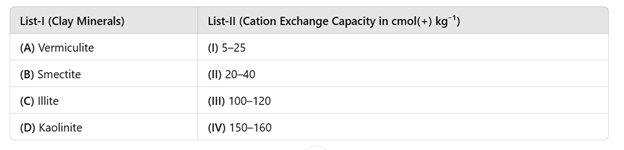
1. Vermiculite → (iv) 150–160 cmol(+) kg⁻¹
- Highest CEC due to high surface charge and expanding structure.
2. Smectite → (iii) 100–120 cmol(+) kg⁻¹
- High CEC because of interlayer expansion and high surface area.
3. Illite → (ii) 20–40 cmol(+) kg⁻¹
- Moderate CEC, with limited exchange due to potassium fixation.
4. Kaolinite → (i) 5–25 cmol(+) kg⁻¹
- Lowest CEC as it is a non-expanding clay with minimal charge.
Information Booster:
1. Cation Exchange Capacity (CEC):
- It refers to the ability of soil or clay minerals to retain and exchange positively charged ions (cations).
- Higher CEC means greater nutrient-holding capacity.
2. Vermiculite:
- It has the highest CEC among the listed minerals due to its expanding lattice structure.
- Used in horticulture and soil conditioning.
3. Smectite:
- It has a high CEC due to its high surface area and ability to absorb water.
- Montmorillonite, a type of smectite, is used in soil amendments.
4. Illite:
- Has a moderate CEC due to potassium-rich structure that prevents full expansion.
- Commonly found in sedimentary rocks and weathered soils.
5. Kaolinite:
- Has the lowest CEC since it lacks an interlayer space for cation exchange.
- Predominantly found in tropical soils and used in ceramics and paper industries.
6. Importance of CEC in Agriculture:
- Higher CEC means better nutrient retention and soil fertility.
- Soils with low CEC require frequent fertilizer application.
Additional Information:
· Vermiculite: Used in potting mixes, improves aeration and water retention.
· Smectite: Expands significantly when wet, making it important in industrial applications like drilling muds.
· Illite: Often found in weathered soils and is a transition between high and low CEC clays.
· Kaolinite: Highly stable and resistant to weathering, making it suitable for ceramics and cosmetics.
· CEC is influenced by:
- Soil pH: Higher pH generally increases CEC.
- Organic Matter: More organic matter increases CEC due to functional groups.
- Clay Type: Expanding clays like smectite have higher CEC than non-expanding ones like kaolinite.
· Application in Soil Management:
- High CEC soils hold nutrients better, reducing the need for fertilizers.
- Low CEC soils require more frequent fertilization to sustain crop productivity.
 English
 10 Questions
 20 Marks
 12 Mins