Correct option is C
Concept:
Linear Transformation:
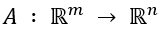
A linear transformation is a function A between two vector spaces that preserves the operations of vector addition and scalar multiplication. In this case, A is a linear transformation from Rm (an m-dimensional space) to Rn (an n-dimensional space).
One-to-One (Injective):
A linear transformation is injective if distinct vectors in Rm are mapped to distinct vectors in Rn. In terms of matrices, A is injective if its null space only contains the zero vector.
Onto (Surjective):
A linear transformation is surjective if for every vector in Rn, there is at least one vector in R^m that maps to it. In terms of matrices, A is surjective if its image spans the entire space R^n.
Bijective:
A linear transformation is bijective if it is both injective (one-to-one) and surjective (onto). A bijection implies that the linear transformation has an inverse, meaning A can map Rm to Rn perfectly without losing or repeating information.
Explanation:
Option 1:
Consider the set X = {1, 2, 3}, so m = 3, and the set Y = {a, b, c, d}, so n = 4.
Define the function A: X → Y by A(1) = a, A(2) = b, and A(3) = c.
- This function is one-to-one (no two elements in X map to the same element in Y).
- However, it is not onto because the element d in Y is not mapped by any element of X.
In this case, m = 3 and n = 4, but m < n. Thus, the function is injective but not surjective, providing a counterexample to the condition m > n.
Option 2:
Consider the set X = {1, 2, 3, 4}, so m = 4, and the set Y = {a, b, c}, so n = 3.
Define the function A: X → Y by A(1) = a, A(2) = b, A(3) = c, and A(4) = c.
- This function is onto because every element in Y is mapped by some element in X.
- However, it is not one-to-one because two elements in X (3 and 4) map to the same element c in Y.
In this case, m = 4 and n = 3, but m > n. Therefore, the function is surjective but not injective, providing a counterexample to the condition m < n.
Option 3:
A transformation is bijective if it is both one-to-one and onto, meaning every element of R^n has a unique preimage in Rm. This can only happen if m = n, so this is a correct statement.
Option 4:
Consider the set X = {1, 2, 3}, so m = 3, and the set Y = {a, b, c, d}, so n = 4.
Define the function A: X → Y by A(1) = a, A(2) = b, and A(3) = c.
- This function is one-to-one (injective) because no two elements of X map to the same element of Y.
- However, m is not equal to n, as m = 3 and n = 4.
Thus, the function is injective but m is not equal to n, providing a valid counterexample.
Final Conclusion:
The correct statement is Option c.