Correct option is D
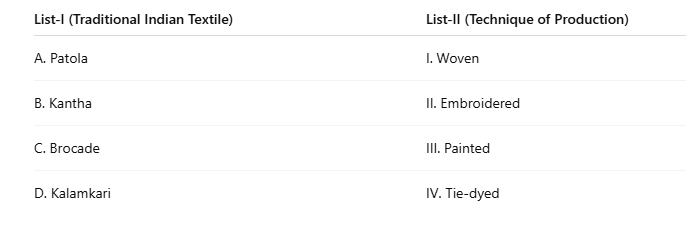
Warp-ikat is a traditional dyeing technique where the warp yarns (vertical threads) are tie-dyed before weaving to create intricate patterns. It is an age-old method used in various regions of India, notably:
1.
Patan (a): Famous for Patan Patola, a double ikat weaving style where both warp and weft are resist-dyed.
2.
Tanjore (b): Known for certain traditional weaving styles including ikat, though limited in scale.
3.
Kanchipuram (c): While it is primarily known for Kanchipuram silk sarees, some warp ikat influence is seen in blended techniques.
4.
Surat (d): Incorrect option for warp ikat production – Surat is primarily a center for synthetic textiles, zari work, and printed fabrics, not for warp ikat weaving.
Information Booster:
·
Warp-ikat techniques are most prominent in Gujarat, Odisha, Andhra Pradesh, and Telangana, where it is known as Patola (Gujarat) and Telia Rumal (Telangana).
·
These techniques require meticulous dyeing of warp yarns, following precise design calculations.
Additional Knowledge:
·
Surat is a major hub of power loom and synthetic fabric industries, producing polyester, nylon, rayon, and printed sarees, not traditional handwoven ikat.
·
Ikat weaving demands handloom and skilled craftsmanship, which is not associated with Surat's industrial textile nature.
 English
 10 Questions
 20 Marks
 12 Mins