Correct option is D
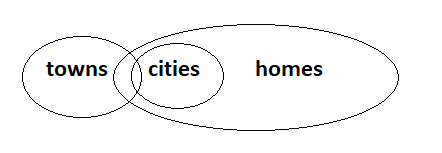
I. Some towns are homes (True, some area of towns are also homes)
II. Some homes are cities (True, as all cities are homes then also some cities are homes)
Both conclusions I and II follow







I. Some towns are homes (True, some area of towns are also homes)
II. Some homes are cities (True, as all cities are homes then also some cities are homes)
Both conclusions I and II follow
 English
 100 Questions
 100 Marks
 90 Mins English English100 Questions100 Marks90 Mins English English40 Questions30 Marks25 Mins English
Read the given statements and conclusions carefully. Assuming that the information given in the statements is true, even if it appears to be at variance with commonly known facts, decide which of the given conclusions logically follow(s) from the statements.
Statements:
Some bubbles are foams.
Some foams are mattresses.
All mattresses are sofas.
Conclusions:
(I) Some foams are sofas.
(II) Some bubble are mattresses.
Read the given statements and conclusions carefully. Assuming that the information given in the statements is true, even if it appears to be at variance with commonly known facts, decide which of the given conclusion(s) logically follow(s) from the statements.
Statements:
All houses are building.
Some buildings are monument.
Some monuments are palace.
Conclusions:
(I) Some palaces are house.
(II) Some monuments are house.
Read the given statements and conclusions carefully. Assuming that the information given in the statements is true, even if it appears to be at variance with commonly known facts, decide which of the given conclusions logically follow(s) from the statements.
Statements:
1. All markers are pens.
2. All markers are sketches.
3. All markers are chalks.
Conclusions:
I. All pens are chalks.
II. Some chalks are sketches.
Read the given statements and conclusions carefully. Assuming that the information given in the statements is true, even if it appears to be at variance with commonly known facts, decide which of the given conclusions logically follow(s) from the statements.
Statements:
1. All geysers are fans.
2. No fan is a refrigerator.
Conclusions:
I. No geyser is a refrigerator.
II. Some refrigerators are fans.
Read the given statements and conclusions carefully. Assuming that the information given in the statements is true, even if it appears to be at variance with commonly known facts, decide which of the given conclusions logically follow(s) from the statements.
Statements:
1. All melons are lemons.
2. No lemon is a pea.
Conclusions:
I. No lemon is a melon.
II. No melon is a pea.
Read the following statement carefully and identify the conclusion that follows.
Statement:
Some stars are planets. No planet is a comet.
Conclusions:
I. Some stars are not comets.
II. All comets are planets.
Read the following statement carefully and identify the conclusion that follows.
Statement:
All poets are writers. Some writers are thinkers. All thinkers are critics.
Conclusions:
I. Some poets are critics.
II. Some writers are critics.


Suggested Test Series

Suggested Test Series
