






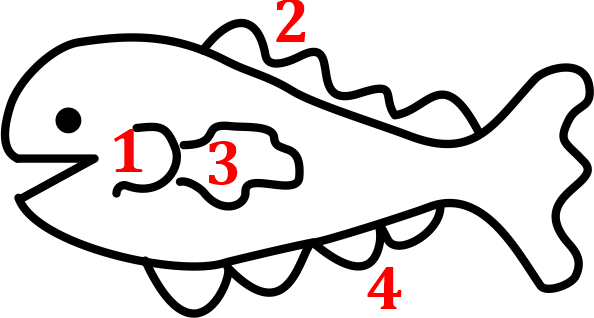
Correct option is C
The correct answer is (C) Position 1.
- Gills The gills in fish are used to assist with breathing.
- The majority of fish have gills on each side of their heads.
- A huge surface area for gas exchange is provided by the tissues known as gills, which are composed of feathery structures known as gill filaments. Aquatic organisms need a lot of surface area for gas exchange because the water's dissolved oxygen content is so low.
- The rows of fish gill filaments are arranged in the gill arch. Lamellae, which are discs dotted with capillaries, make up each filament.
- Through these tiny blood arteries, blood enters and exits the gills. Even though fish's gills only cover a small portion of their bodies, the large respiratory surface that filaments create gives the entire creature effective gas exchange.
- Fish use their mouths to pump oxygen-rich water over their gills. The blood inside the capillary network absorbs the dissolved oxygen as water flows over the gill filaments.
- The circulatory system then transports carbon dioxide from the body, which is expelled by the gills, and distributes oxygen to all body tissues before reaching the cells.Once the water has passed the gills, it leaves the fish's body through openings on the sides of the throat or through the operculum, a flap that is typically found in bony fish and covers and shields the gills.
- Several fish have several gill openings, including sharks and lampreys. Bony fish called rohu only has one gill opening on either side.
 English
 100 Questions
 100 Marks
 90 Mins


