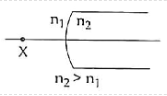
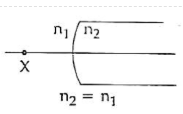
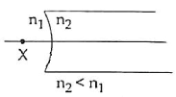
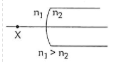
Correct option is D
The correct answer is (d) The emergent ray is parallel to the incident ray.
· When light passes through a glass slab, it bends (refracts) upon entering and exiting the slab due to the change in medium (air to glass and glass to air).
· The incident ray and the emergent ray are parallel to each other because the glass slab has parallel faces.
· The lateral shift occurs due to refraction, but the emergent ray remains parallel to the original incident ray.
· The bending of light follows Snell's Law, which states that the ratio of the sine of the angle of incidence to the sine of the angle of refraction is a constant.
Information Booster:
· The emergent and incident rays are not random; they follow a predictable path based on the laws of refraction.
· The emergent ray is not at 90 degrees; it is parallel to the incident ray after refraction through a glass slab.
· The incident ray does bend while passing through the slab, and while the emergent ray is parallel to the incident ray, they are laterally shifted.
 English
 100 Questions
 100 Marks
 90 Mins