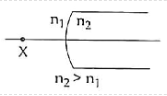
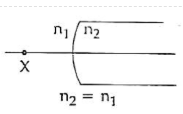
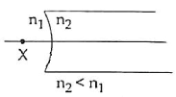
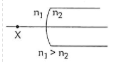
Correct option is C
The correct answer is (c) It is always greater than 1.
Explanation:
• In optical physics, the absolute refractive index (n) of a medium is defined as the ratio of the speed of light in vacuum (c) to the speed of light in that medium (v).
• The formula is:
n = c / v
• The speed of light is maximum in vacuum (about 3 × 10⁸ m/s). When light travels through any material medium such as air, water, or glass, its speed becomes less than its speed in vacuum.
• Therefore, c is always greater than v for any material medium.
• As a result, the ratio c / v will always be greater than 1.
• For air, the refractive index is very close to 1 (about 1.0003), while for denser substances like water or glass, the value is higher.
Information Booster:
• Diamond has one of the highest refractive indices among common natural substances, about 2.42.
• Refractive index is a dimensionless quantity, meaning it has no units because it is a ratio of two speeds.
Additional Knowledge:
It is always equal to 1 (Option a)
• This is only true when light travels in a perfect vacuum.
It is always less than 1 (Option b)
• This would mean light travels faster in a medium than in vacuum, which is not possible according to physics.
It is always negative (Option d)
• This is incorrect because refractive index is always a positive quantity.
 English
 100 Questions
 100 Marks
 90 Mins