Correct option is B
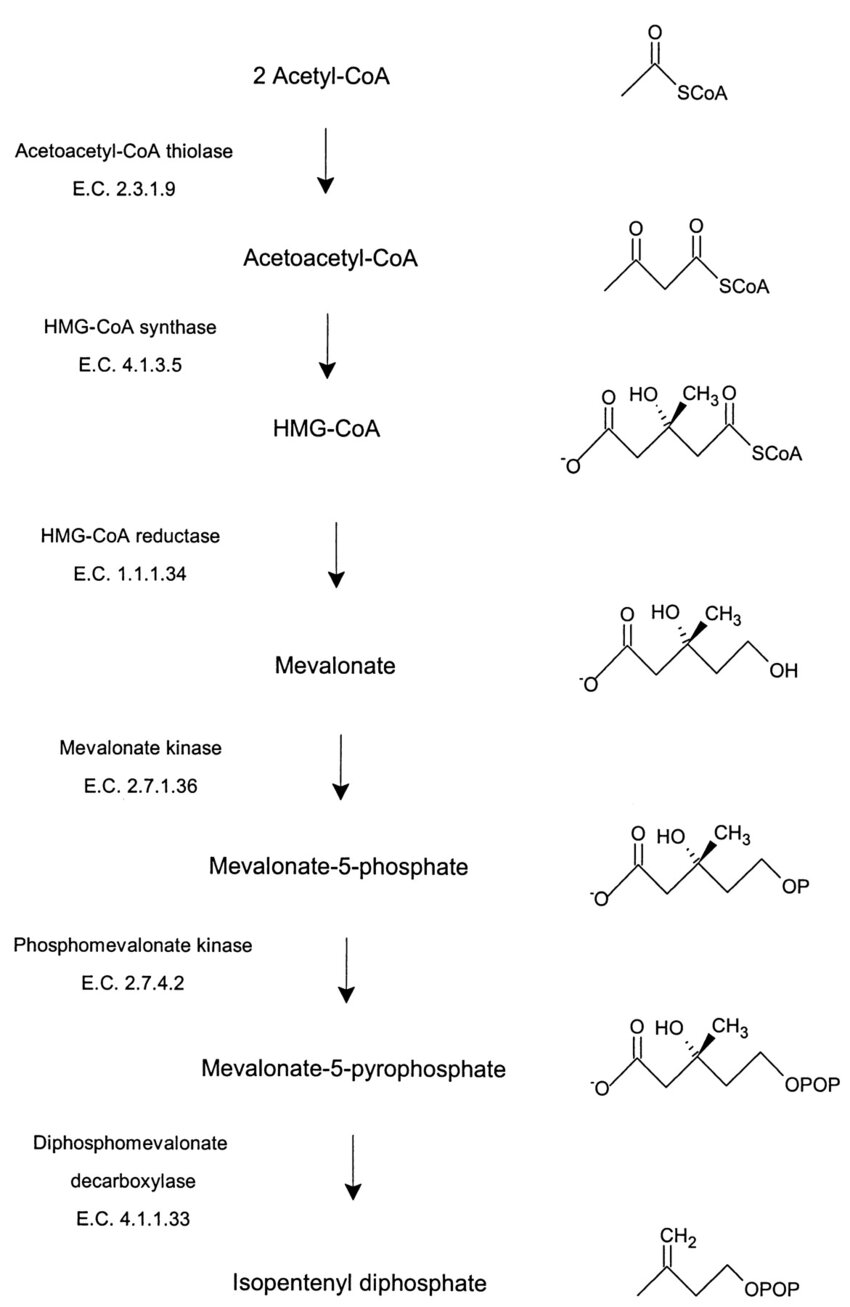
In the mevalonate pathway, three molecules of acetyl-CoA are condensed to form isopentenyl diphosphate (IPP), a precursor for the biosynthesis of terpenoids. The process involves several steps, including the condensation of two acetyl-CoA molecules to form acetoacetyl-CoA, which then condenses with a third acetyl-CoA molecule to form mevalonate. Mevalonate is then converted into IPP, which serves as the building block for the synthesis of various terpenoids.
Steps of the Mevalonate Pathway:
- Two molecules of acetyl-CoA condense to form acetoacetyl-CoA.
- Acetoacetyl-CoA condenses with another acetyl-CoA molecule to form HMG-CoA (3-hydroxy-3-methylglutaryl-CoA).
- HMG-CoA is then reduced to mevalonate.
- Mevalonate is subsequently converted to isopentenyl diphosphate (IPP), the key precursor for terpenoid synthesis.
Information Booster:
- Acetyl-CoA is derived from carbohydrates, fatty acids, and proteins and is the starting material for many biosynthetic pathways.
- Isopentenyl diphosphate (IPP) is the basic building block for the biosynthesis of terpenoids, which are involved in various plant processes, including growth, defense, and reproduction.
- The mevalonate pathway is one of the main terpenoid biosynthesis pathways in eukaryotes, especially in plants, fungi, and animals.
- The formation of terpenoids involves head-to-tail polymerization of IPP molecules, eventually forming larger units such as geranyl pyrophosphate (GPP), farnesyl pyrophosphate (FPP), and geranylgeranyl pyrophosphate (GGPP).