






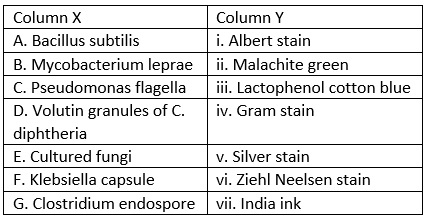
Correct option is D
EXPLANATION-
(A) Bacillus subtilis — Gram stain (iv)
Bacillus subtilis is a gram-positive bacterium, commonly stained using the Gram stain method to differentiate it from gram-negative bacteria.
(B) Mycobacterium leprae — Ziehl Neelsen stain (vi)
Mycobacterium leprae has a waxy cell wall containing mycolic acid. The Ziehl-Neelsen stain (acid-fast stain) is used to identify it.
(C) Pseudomonas flagella — Silver stain (v)
Flagella are delicate and require special staining techniques like silver staining to be visualized.
(D) Volutin granules of C. diphtheriae — Albert stain (i)
Volutin granules are polyphosphate storage granules, stained specifically by Albert stain.
(E) Cultured fungi — Lactophenol cotton blue (iii)
Fungi cell walls are stained well with Lactophenol cotton blue to observe fungal structures.
(F ) Klebsiella capsule — India ink (vii)
The capsule is a polysaccharide layer around bacteria like Klebsiella. India ink is used for negative staining of capsules.
(G) Clostridium endospore — Malachite green (ii)
Endospores are stained using Malachite green, while vegetative cells are counterstained with safranin.
So, the correct option is (d) - E-iii, C-v, D-i


