
Correct option is D
Why is (A) Incorrect?
- Cronbach’s alpha measures internal consistency reliability, which applies best to continuous-scale items (e.g., Likert scale) rather than dichotomous (True/False) items.
- For dichotomous items, a better measure of reliability is the Kuder-Richardson Formula 20 (KR-20).
- Cronbach’s alpha can still be used for True/False tests but is not the best choice.
Why is (R) Correct?
- Cronbach’s alpha is a widely accepted measure of internal consistency, which assesses how closely related a set of test items are.
- A higher Cronbach’s alpha value indicates greater reliability.
Thus, while (R) is correct, (A) is incorrect, making Option (4) the correct answer.
Information Booster:
Cronbach’s Alpha (α):
Measures internal consistency for tests with continuous responses (e.g., Likert-scale items).
Formula
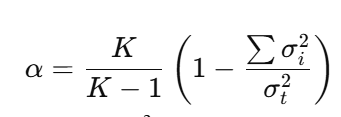
Where K = number of items, σ²_i = variance of individual items, σ²_t = total variance.
Kuder-Richardson Formula 20 (KR-20):
Specifically designed for dichotomous (True/False, Yes/No) items.
More appropriate than Cronbach’s alpha for tests with binary scoring.
Types of Reliability Measures:
Test-Retest Reliability: Stability over time.
Inter-Rater Reliability: Agreement between different raters.
Split-Half Reliability: Measures test consistency by splitting into two halves.
Internal Consistency Reliability: Measured using Cronbach’s alpha or KR-20/KR-21.
Applications in Psychology & Education:
Used in psychometric testing, personality assessments, and survey validation.
Ensures questionnaires and psychological tests are reliable.
Limitations of Cronbach’s Alpha:
Assumes unidimensionality (all items measure a single construct).
Influenced by the number of test items (longer tests tend to have higher alpha values).
 English
 10 Questions
 20 Marks
 12 Mins


