

hamburger menu
All Coursesall course arrow
adda247
reward-icon
adda247
    arrow
    arrow
    arrow
    Given below are names and recognition sequences of a few restriction enzymes that are used for cloning experiments. The cleavage site of each enzyme i
    Question

    Given below are names and recognition sequences of a few restriction enzymes that are used for cloning experiments. The cleavage site of each enzyme is indiceted by 

    EcoRI-G'AATTC

    HincII - GTY'RAC

    EcoRV-GAT'ATC

    BamHI-G 'GATCC

    BglII-A 'GATCT

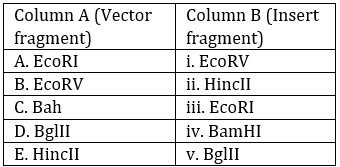
    Given below are different vector (Column A) and insert (Column B) fragments generated by digestion using the above enzymes: 

    Which one of the following options represents the correct combinations of the vector and insert, respectively, which generate compatible ends for ligation?

    A.

    A - ii, B - v, C - iv

    B.

    B - ii, D - iv, E - i

    C.

    A - v, C - i, E - iii

    D.

    C - iv, D - i, E - ii

    Correct option is A

    The question revolves around understanding the recognition sequences and cleavage sites of the given restriction enzymes, and matching vector fragments with insert fragments that create compatible cohesive ends for ligation.

    • EcoRI recognizes G^AATTC, cutting between G and A, producing sticky ends.

    • HincII recognizes GTY^RAC, cutting within the sequence, producing blunt ends.

    • EcoRV recognizes GAT^ATC, producing blunt ends.

    • BamHI recognizes G^GATCC, producing sticky ends.

    • BglII recognizes A^GATCT, producing sticky ends compatible with BamHI ends.

    The key to this problem is that fragments produced by enzymes that create compatible sticky ends can be ligated successfully.

    • EcoRI sticky ends are compatible with EcoRI sticky ends only.

    • BamHI and BglII generate compatible sticky ends (both generate 5' overhangs of GATC).

    • HincII and EcoRV produce blunt ends, which can ligate with each other but less efficiently.

    Looking at the options and the table:

    • Option B pairs EcoRV (vector fragment) with HincII (insert fragment) - both blunt ends, compatible.

    • D pairs BglII with BamHI - compatible sticky ends.

    • E pairs HincII with BglII is incorrect because HincII produces blunt ends, and BglII sticky ends are not compatible with blunt ends.

    • A pairs EcoRI with EcoRV (sticky with blunt) - not compatible.

    • C pairs BamHI with EcoRI (sticky ends with different overhangs) - incompatible.

    Therefore, option (b) is the only one with correct compatible ends.

    Similar Questions

    test-prime-package

    Access ‘CSIR NET Life Sciences’ Mock Tests with

    • 60000+ Mocks and Previous Year Papers
    • Unlimited Re-Attempts
    • Personalised Report Card
    • 500% Refund on Final Selection
    • Largest Community
    students-icon
    354k+ students have already unlocked exclusive benefits with Test Prime!
    test-prime-package

    Access ‘CSIR NET Life Sciences’ Mock Tests with

    • 60000+ Mocks and Previous Year Papers
    • Unlimited Re-Attempts
    • Personalised Report Card
    • 500% Refund on Final Selection
    • Largest Community
    students-icon
    354k+ students have already unlocked exclusive benefits with Test Prime!
    Our Plans
    Monthsup-arrow
