






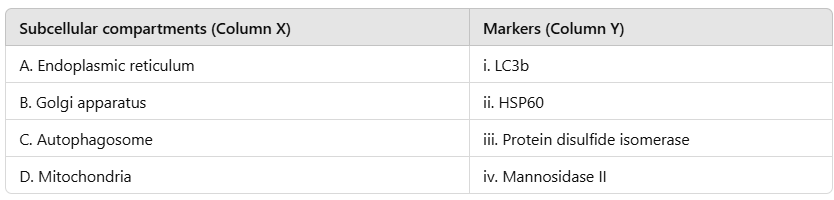
Correct option is A
Subcellular Compartments and Their Markers:
A. Endoplasmic Reticulum (ER)
- Marker for ER: Protein disulfide isomerase (PDI)
- PDI is a well-known marker for the endoplasmic reticulum. It is a chaperone protein that plays a key role in protein folding and disulfide bond formation within the ER. The ER is where a large amount of protein folding occurs, and PDI is involved in the oxidation, reduction, and isomerization of disulfide bonds.
- Therefore, A-iii (PDI) is the correct match for Endoplasmic Reticulum.
B. Golgi Apparatus
- Marker for Golgi: Mannosidase II
- Mannosidase II is a glycosylation enzyme located in the Golgi apparatus. It catalyzes the hydrolysis of the mannose residues in glycoproteins, which is crucial for the final stages of N-linked glycosylation that occurs in the Golgi. This makes Mannosidase II a specific marker for the Golgi apparatus.
- Therefore, B-iv (Mannosidase II) is the correct marker for the Golgi apparatus.
C. Autophagosome
- Marker for Autophagosome: LC3b
- LC3b (Microtubule-associated protein 1A/1B-light chain 3) is a key marker for the autophagosomes. Autophagosomes are the vesicles involved in the autophagy process, where damaged organelles or misfolded proteins are engulfed and transported to the lysosome for degradation.
- LC3b is conjugated to phosphatidylethanolamine on the autophagosome membrane during autophagy, and it is widely used as a marker for autophagic vesicles.
- Therefore, C-i (LC3b) is the correct marker for the Autophagosome.
D. Mitochondria
- Marker for Mitochondria: HSP60
- HSP60 (Heat shock protein 60) is a mitochondrial chaperonin. It is a chaperone protein that is involved in protein folding inside the mitochondria. HSP60 is essential for ensuring that newly synthesized mitochondrial proteins fold correctly and mature to become functional.
- Therefore, D-ii (HSP60) is the correct marker for Mitochondria.


