






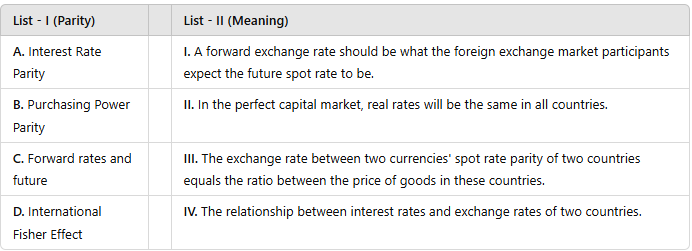
Correct option is A
The correct match is:
- Interest Rate Parity (A-IV): Interest Rate Parity (IRP) describes the relationship between interest rates and exchange rates between two countries. It states that the difference in interest rates between two countries is equal to the difference between the forward exchange rate and the spot exchange rate. This prevents arbitrage opportunities in the forex market.
- Purchasing Power Parity (B-III): Purchasing Power Parity (PPP) states that the exchange rate between two countries should be equal to the ratio of the price levels of goods in those countries. It implies that in the long run, identical goods should cost the same in different countries when expressed in a common currency.
- Forward Rates and Future (C-I): The forward exchange rate should be what market participants expect the future spot rate to be. This is because forward contracts and futures are used to hedge against expected fluctuations in exchange rates.
- International Fisher Effect (D-II): The International Fisher Effect (IFE) suggests that in a perfect capital market, real interest rates will be the same across countries. It predicts that a country with a higher nominal interest rate will experience a proportional depreciation in its currency due to higher inflation.
Information Booster:
- IRP is a fundamental principle in forex trading and prevents arbitrage opportunities.
- It ensures that the difference between domestic and foreign interest rates is equal to the difference between the forward exchange rate and the spot exchange rate.
- Covered IRP (CIRP): Involves the use of forward contracts to hedge against currency risk.
- Uncovered IRP (UIRP): Assumes future spot rates will adjust based on interest rate differentials without hedging.
- IRP plays a key role in setting forward exchange rates and helps multinational companies manage currency risks.
Additional Knowledge:
Purchasing Power Parity (B-II) – Incorrect
- PPP deals with the exchange rate being equal to the price ratio of goods in two countries, not the equality of real interest rates across countries.
- The correct match is III, as PPP ensures that identical goods have the same price in different countries when converted into a common currency.
Forward Rates and Future (C-II) – Incorrect
- Forward rates are determined based on expected future spot rates, not real interest rate parity across nations.
- The correct match is I because forward rates reflect market expectations of future exchange rates.
International Fisher Effect (D-III) – Incorrect
- The Fisher Effect describes the relationship between interest rates and exchange rates, not price level parity.
- The correct match is II because IFE states that real interest rates remain equal in a perfect capital market.
 English
 10 Questions
 20 Marks
 12 Mins


