Correct option is A
The correct match is:
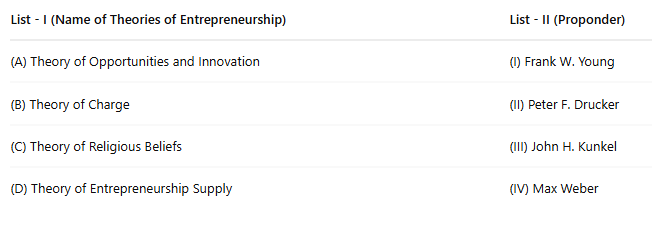
(A) Theory of Opportunities and Innovation → (II) Peter F. Drucker
Drucker proposed that entrepreneurship is essentially about innovation and exploiting opportunities. Entrepreneurs don't just manage businesses—they innovate by converting a need into a business opportunity.(B) Theory of Charge → (I) Frank W. Young
Young's sociological theory explains that entrepreneurship arises due to group dynamics and status change (charge) within a society. He saw entrepreneurship as a result of inter-group relationships.(C) Theory of Religious Beliefs → (IV) Max Weber
Weber linked entrepreneurship to cultural and religious values, especially Protestant ethics. His theory emphasized that religious beliefs, especially those promoting thrift, hard work, and saving, influence entrepreneurial behavior.(D) Theory of Entrepreneurship Supply → (III) John H. Kunkel
Kunkel emphasized the supply-side approach, asserting that the supply of entrepreneurs depends on cultural, economic, and social forces in the environment.
Information Booster:
Peter F. Drucker viewed innovation as a discipline and practice, not just a trait.
Frank W. Young believed that social transformation and community-based dynamics trigger entrepreneurial emergence.
Max Weber’s work “The Protestant Ethic and the Spirit of Capitalism” is a classic in linking culture to entrepreneurship.
John H. Kunkel focused on environmental conditions that affect the availability of entrepreneurs in a society.
Weber’s theory underscores that economic behavior is heavily influenced by non-economic factors.
Drucker considered systematic innovation to be central to entrepreneurship, focusing on technological and market changes.
Young’s idea of “charge” reflects status frustration, often seen in marginalized or minority groups trying to assert identity through enterprise.
 English
 10 Questions
 20 Marks
 12 Mins