Correct option is B
Introduction:
Finance for business refers to the processes of acquiring, managing, and allocating funds to ensure smooth operations and long-term growth.
Information Booster:
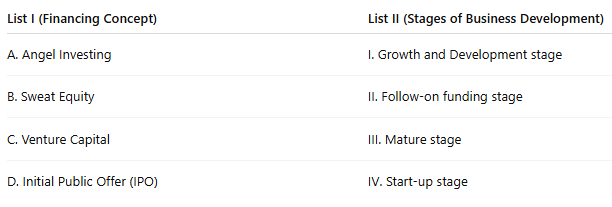
A. Angel Investing → IV. Start-up Stage:
Angel investors provide seed capital during the early stage or start-up phase when businesses lack access to formal funding. This is typically the first external equity investment.
B. Sweat Equity → III. Mature Stage:
Sweat equity refers to ownership earned by effort rather than capital. It is often recognized formally in the mature stage, where founders or key employees are compensated with equity for their past contributions.
C. Venture Capital → II. Follow-on Funding Stage:
Venture capital typically comes after the angel investment and is used in the expansion or follow-on funding phase, supporting scalability, market development, or product diversification.
D. IPO → I. Growth and Development Stage:
Initial Public Offerings (IPO) are used in the growth and development stage to raise substantial public funds and enhance credibility. Businesses are more stable and prepared for regulation and public scrutiny at this stage.
Additional Knowledge:
Angel Investing is typically informal and bridges the gap between personal funds and venture capital.
Sweat Equity builds long-term commitment from key contributors and is formalized as the business matures.
Venture Capital supports fast-scaling and high-growth companies after initial proof of concept is achieved.
IPO gives access to a wide pool of investors and is a strategic tool for expansion, acquisition, or debt repayment.
This financing sequence is essential in entrepreneurial finance and business planning.
 English
 10 Questions
 20 Marks
 12 Mins