Correct option is C
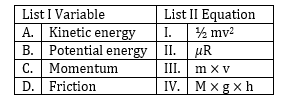
The kinetic energy (KE) of an object is given by the formula:
KE=12mv2KE = \frac{1}{2} mv^2KE=21mv2
Where:
· mmm is the mass of the object,
· vvv is the velocity of the object.
Kinetic energy is directly proportional to the square of the velocity:
KE∝v2KE \propto v^2KE∝v2
When the velocity triples: Let the initial velocity be vvv, and the initial kinetic energy be KE1=12mv2KE_1 = \frac{1}{2} mv^2KE1=21mv2. When the velocity becomes 3v3v3v:
KE2=12m(3v)2=12m(9v2)=9×KE1KE_2 = \frac{1}{2} m (3v)^2 = \frac{1}{2} m (9v^2) = 9 \times KE_1KE2=21m(3v)2=21m(9v2)=9×KE1
Thus, the kinetic energy increases 9 times when the velocity triples.
Correct Answer:
(c) It increases 9 times
Information Booster 1. Kinetic Energy Relation:
· KE∝v2KE \propto v^2KE∝v2, meaning any change in velocity results in a squared change in kinetic energy.
2. Practical Examples:
· Doubling the velocity increases the kinetic energy by 4×4 \times4×.
· Tripling the velocity increases the kinetic energy by 9×9 \times9×.
3. Importance in Physics:
· Kinetic energy calculations are essential in understanding motion, collisions, and energy conservation in mechanical systems.
 English
 150 Questions
 150 Marks
 150 Mins