arrow
arrow
arrow
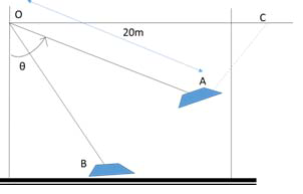
As shown in the figure, the plane, having a mass of 8000 kg, is hoisted back until θ = 60°\degree° and then the pull-back cable AC is released wh
Question

As shown in the figure, the plane, having a mass of 8000 kg, is hoisted back until θ = 60°\degree and then the pull-back cable AC is released when the plane is at rest. Determine the speed of the plane just  before it crashes into the ground at θ =30°\degree . (Neglect the size of the plane and effect of lift caused by the wings during the motion, assume g = 10 m/s2m/s^2​)

A.

23.98 m/s

B.

12.1 m/s

C.

9.56 m/s

D.

6.76 m/s

Correct option is B

Apply Conservation of EnergyLet:m=8000 kgg=10 m/s2Radius of arc=20 mInitial angle=θ1=60Final angle=θ2=30\textbf{Apply Conservation of Energy} \\\text{Let:} \\m = 8000\, \text{kg} \\g = 10\, \text{m/s}^2 \\\text{Radius of arc} = 20\, \text{m} \\\text{Initial angle} = \theta_1 = 60^\circ \\\text{Final angle} = \theta_2 = 30^\circ

Use vertical height from point O:h=Rcos(θ)Initial height: h1=20cos(60)=200.5=10 mFinal height: h2=20cos(30)=2032200.866=17.32 mSince it’s falling from higher to lower:Δh=h1h2=1017.32=7.32 mWait — this seems incorrect. Actually:At θ=60, the vertical height is higher than at θ=30Correct heights are:h60=20sin(60)=200.866=17.32 mh30=20sin(30)=200.5=10 mSo:Δh=17.3210=7.32 mStep 3: Conservation of Mechanical EnergyInitial PE = Final PE + Final KEmgh=12mv2=>v=2gh=2107.32=146.412.1 m/s\text{Use vertical height from point O:} \\h = R \cdot \cos(\theta) \\\\\text{Initial height: } h_1 = 20 \cos(60^\circ) = 20 \cdot 0.5 = 10\, \text{m} \\\text{Final height: } h_2 = 20 \cos(30^\circ) = 20 \cdot \frac{\sqrt{3}}{2} \approx 20 \cdot 0.866 = 17.32\, \text{m} \\\\\text{Since it's falling from higher to lower:} \\\Delta h = h_1 - h_2 = 10 - 17.32 = -7.32\, \text{m} \\\\\text{Wait — this seems incorrect. Actually:} \\\text{At } \theta = 60^\circ, \text{ the vertical height is \textbf{higher} than at } \theta = 30^\circ \\\text{Correct heights are:} \\h_{60^\circ} = 20 \cdot \sin(60^\circ) = 20 \cdot 0.866 = 17.32\, \text{m} \\h_{30^\circ} = 20 \cdot \sin(30^\circ) = 20 \cdot 0.5 = 10\, \text{m} \\\\\text{So:} \\\Delta h = 17.32 - 10 = 7.32\, \text{m} \\\\\textbf{Step 3: Conservation of Mechanical Energy} \\\text{Initial PE = Final PE + Final KE} \\mgh = \frac{1}{2}mv^2 \Rightarrow v = \sqrt{2gh} = \sqrt{2 \cdot 10 \cdot 7.32} = \sqrt{146.4} \approx \boxed{12.1\, \text{m/s}}​​​

test-prime-package

Access ‘ISRO Mechanical Engineering’ Mock Tests with

  • 60000+ Mocks and Previous Year Papers
  • Unlimited Re-Attempts
  • Personalised Report Card
  • 500% Refund on Final Selection
  • Largest Community
students-icon
353k+ students have already unlocked exclusive benefits with Test Prime!
test-prime-package

Access ‘ISRO Mechanical Engineering’ Mock Tests with

  • 60000+ Mocks and Previous Year Papers
  • Unlimited Re-Attempts
  • Personalised Report Card
  • 500% Refund on Final Selection
  • Largest Community
students-icon
353k+ students have already unlocked exclusive benefits with Test Prime!
Our Plans
Monthsup-arrow