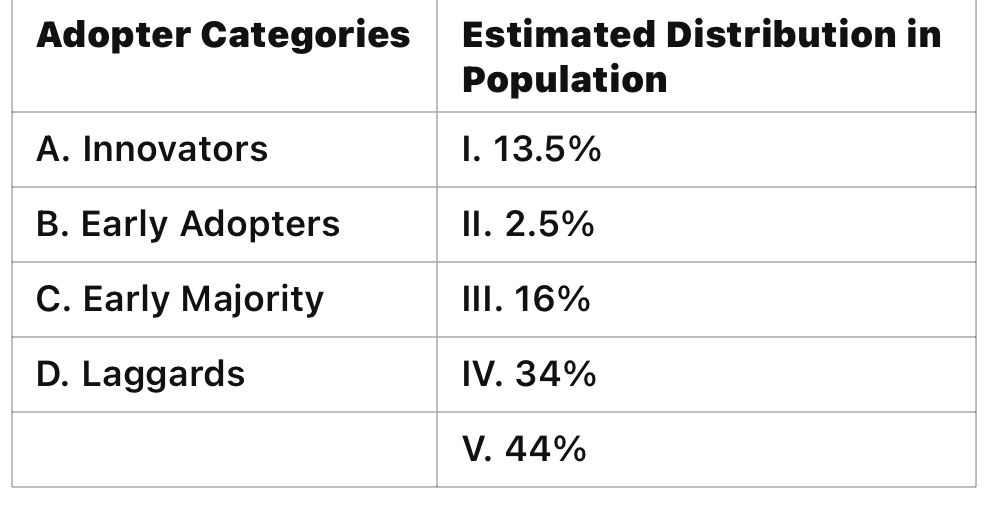
Correct option is B
In Rogers' Diffusion of Innovations theory, the Early Majority category includes individuals who:
· Adopt innovations just before the average person.
· Are deliberate in their decision-making process — they take time, carefully observe others' experiences, and prefer proven outcomes. ( B)
· Are well connected within their local peer groups, but not strongly connected with outsiders or change agents. ( D)
· Tend to be less cosmopolitan and moderately educated, so E (less likely to be educated) holds relatively true when compared to earlier adopter categories. ( E)
Information Booster:
Rogers classifies adopters into five categories:
1. Innovators – Risk-takers, cosmopolitan, well-educated
2. Early Adopters – Opinion leaders, socially forward, educated
3. Early Majority – Deliberate, cautious, influenced by peer networks
4. Late Majority – Skeptical, adopt under pressure or social norms
5. Laggards – Tradition-bound, least exposed to innovation
The Early Majority play a key role in spreading adoption after early adopters, but they are not risk-loving, and often wait until innovations have been tested by others.
Additional Knowledge:
· A (Well educated) is not typically a feature of Early Majority; this applies more to Innovators and Early Adopters.
· C (Risk loving) is incorrect — Early Majority are risk-averse, not adventurous like Innovators.
 English
 10 Questions
 20 Marks
 12 Mins