arrow
arrow
arrow
A uniform magnetic field of 2 T exists in a cylindrical region of radius 10 cm, itsdirection parallel to the axis along east to west. A wire carrying
Question

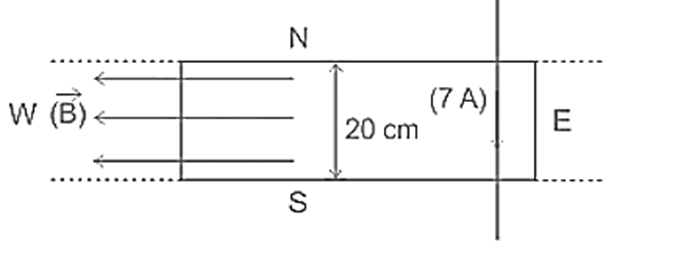
A uniform magnetic field of 2 T exists in a cylindrical region of radius 10 cm, itsdirection parallel to the axis along east to west. A wire carrying current 6 A in the northto south direction passes through the region. What is the magnitude of the force onthe wire if

(a) the wire intersects the axis

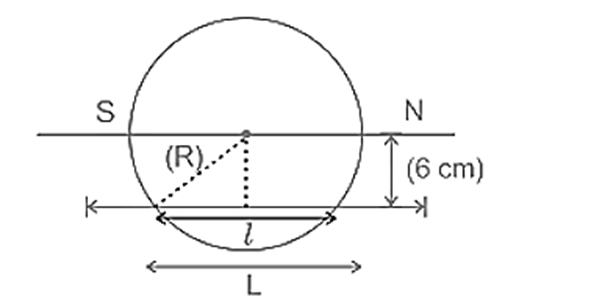
(b) the wire in the N-S direction is lowered from the axis by a distance of 6 cm?

A.

2.4 N, 1.54 N respectively

B.

2.4 N, 1.92 N respectively

C.

2.1 N, 1.54 N respectively

D.

2.1 N, 1.92 N respectively

Correct option is B

Given: Magnetic field strength: B=2 T Current: I=6 A Length of the wire: L=20 cm=0.2 m The direction of the magnetic field is parallel to the axis of the cylinder, from east to west. The wire is carrying current from north to south.Concept:The magnetic force on the wire is given by:F=BILsinθWhere: B is the magnetic field strength, I is the current, L is the length of the wire in the magnetic field, θ is the angle between the direction of the magnetic field and the current.Case a) When the wire intersects the axis (i.e., the angle between the magnetic field and the current is 90°):In this case, θ=90, so sin90=1.Substituting the values:F=2×6×0.2×1=2.4 NThus, the force when the wire intersects the axis is:F=2.4 N\textbf{Given:} \\\bullet \, \text{Magnetic field strength: } B = 2 \, \text{T} \\\bullet \, \text{Current: } I = 6 \, \text{A} \\\bullet \, \text{Length of the wire: } L = 20 \, \text{cm} = 0.2 \, \text{m} \\\bullet \, \text{The direction of the magnetic field is parallel to the axis of the cylinder, from east to west.} \\\bullet \, \text{The wire is carrying current from north to south.} \\\textbf{Concept:} \\\text{The magnetic force on the wire is given by:} \\F = BIL \sin \theta \\\text{Where:} \\\bullet \, B \text{ is the magnetic field strength,} \\\bullet \, I \text{ is the current,} \\\bullet \, L \text{ is the length of the wire in the magnetic field,} \\\bullet \, \theta \text{ is the angle between the direction of the magnetic field and the current.} \\\textbf{Case a) When the wire intersects the axis (i.e., the angle between the magnetic field and the current is 90°):} \\\text{In this case, } \theta = 90^\circ, \, \text{so } \sin 90^\circ = 1. \\\text{Substituting the values:} \\F = 2 \times 6 \times 0.2 \times 1 = 2.4 \, \text{N} \\\text{Thus, the force when the wire intersects the axis is:} \\F = 2.4 \, \text{N}

Case b) When the wire is lowered from the axis by a distance of 6 cm:

​​In this case, we first calculate the new length of the wire in the magnetic field.The radius of the cylindrical region is 10 cm, and the wire is lowered by 6 cm. The length of the wire in contact with the magnetic field will change based on the position of the wire.Let the horizontal distance from the axis to the wire be x, and the total length of the wire in contact with the magnetic field will be 2x.From the geometry, we can calculate:x=10262=10036=64=8 cmThus, the total length of the wire in contact with the magnetic field is:L=2x=2×8=16 cm=0.16 mNow, using the formula for the magnetic force:F=BILsinθSince the wire is still perpendicular to the magnetic field, θ=90, so sin90=1.Substituting the values:F=2×6×0.16×1=1.92 NThus, the force when the wire is lowered is:F=1.92 N\text{In this case, we first calculate the new length of the wire in the magnetic field.} \\\text{The radius of the cylindrical region is } 10 \, \text{cm}, \text{ and the wire is lowered by } 6 \, \text{cm. The length of the wire in contact with the magnetic field will change based on the position of the wire.} \\\text{Let the horizontal distance from the axis to the wire be } x, \text{ and the total length of the wire in contact with the magnetic field will be } 2x. \\\text{From the geometry, we can calculate:} \\x = \sqrt{10^2 - 6^2} = \sqrt{100 - 36} = \sqrt{64} = 8 \, \text{cm} \\\text{Thus, the total length of the wire in contact with the magnetic field is:} \\L = 2x = 2 \times 8 = 16 \, \text{cm} = 0.16 \, \text{m} \\\text{Now, using the formula for the magnetic force:} \\F = BIL \sin \theta \\\text{Since the wire is still perpendicular to the magnetic field, } \theta = 90^\circ, \text{ so } \sin 90^\circ = 1. \\\text{Substituting the values:} \\F = 2 \times 6 \times 0.16 \times 1 = 1.92 \, \text{N} \\\text{Thus, the force when the wire is lowered is:} \\F = 1.92 \, \text{N}​​

Similar Questions

test-prime-package

Access ‘AAI JE ATC’ Mock Tests with

  • 60000+ Mocks and Previous Year Papers
  • Unlimited Re-Attempts
  • Personalised Report Card
  • 500% Refund on Final Selection
  • Largest Community
students-icon
354k+ students have already unlocked exclusive benefits with Test Prime!
test-prime-package

Access ‘AAI JE ATC’ Mock Tests with

  • 60000+ Mocks and Previous Year Papers
  • Unlimited Re-Attempts
  • Personalised Report Card
  • 500% Refund on Final Selection
  • Largest Community
students-icon
354k+ students have already unlocked exclusive benefits with Test Prime!
Our Plans
Monthsup-arrow