






Correct option is A
When a direct current (DC) series motor is mistakenly connected to a single-phase alternating current (AC) supply, several important points must be considered to understand the impact on the torque generated by the motor.
While DC motors are not designed to operate on AC supply due to fundamental differences in their operation and construction, a DC series motor exhibits some unique characteristics that allow it to actually run on AC supply, albeit with some limitations and inefficiencies.
Torque in DC Series Motors on AC Supply:
o Pulsating Torque: The torque generated by a DC series motor when connected to AC supply becomes pulsating rather than constant.
This is because the torque in a motor is proportional to the square of the current.
o Average Torque Value: Although the torque is pulsating, it does not become negative, Therefore, the motor experiences an average torque over a cycle that can still enable rotation.
o Reduced Efficiency and Increased Losses: Operating a DC series motor on AC supply leads to increased losses due to the alternating nature of the current.
These include hysteresis and eddy current losses in the iron core, as well as additional resistive losses in the windings caused by the higher effective resistance (due to skin effect) at AC frequencies.
Consequently, the motor operates with reduced efficiency, and the overall torque output is lower compared to its operation on a DC supply.
o Mechanical Vibrations and Noise: The pulsating torque can cause mechanical vibrations and increased noise during operation, which may lead to premature wear or failure of mechanical components over time.
o Compatibility and Limitations: Although a DC series motor can technically operate on AC supply, it's not optimal or intended by design.
o The motor's performance will be significantly degraded compared to its operation on a compatible DC supply.
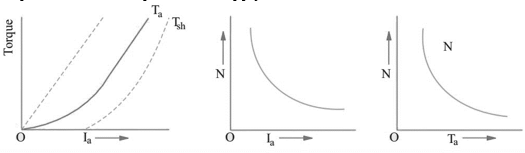
This is because the torque in a series motor is proportional to the square of the current. When connected to an AC supply, the current alternates, and so the torque will fluctuate accordingly. However, due to the nature of the series winding, the direction of the torque will remain the same.


