Time AND Work Questions FOR Bank Exams with Detailed Solutions

Get Time AND Work Questions FOR Bank Exams to prepare for your upcoming exam. Solve the most expected questions and detailed solutions that can be asked in the exam.

Important Time AND Work Questions FOR Bank Exams

Q1.
Three pipes A, B, C can fill a tank alone in 5 hours, 6 hours and 30 hours, respectively. Find the time taken by all three pipes to fill the tank together (in hours)?
  • A.3.5
  • B.1.5
  • C.4.5
  • D.3
  • E.2.5
    ✓ Correct

Answer & Solution

Correct option is E


Information Given:
Pipe A fills tank in 5 hours
Pipe B fills tank in 6 hours
Pipe C fills tank in 30 hours
Concept/Formula Used:
Work rate of all pipes = sum of individual rates
Total time = 1 / (total work rate)
For pipes: rate per hour = 1 / respective time
Explanation:
Pipe A's rate = 1/5
Pipe B's rate = 1/6
Pipe C's rate = 1/30
Combined rate = 1/5 + 1/6 + 1/30 = (6+5+1)/30 = 12/30 = 2/5 tank per hour
Time taken to fill tank = 1 / (2/5) = 5/2 = 2.5 hours
Q2.

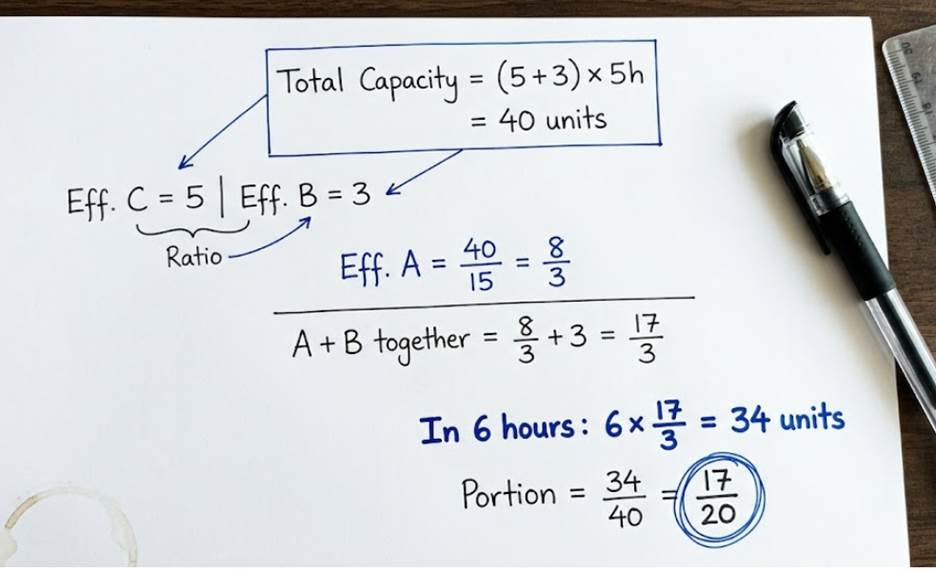
The ratio of efficiency of pipe C to B is 5 : 3 and pipe A alone can fill a tank in 15 hours. If pipe B & C together can fill the tank in 5 hours, then find what portion of the tank will be filled if pipe A & B are opened together for 6 hours.

  • A.

    3/5

  • B.

    7/10

  • C.

    17/20

    ✓ Correct
  • D.

    5/8

  • E.

    11/20

Answer & Solution

Correct option is C

​​​
Information Given:
Efficiency ratio of pipe C : B = 5 : 3
Time taken by pipe A alone = 15 hours
Pipes B & C together fill tank in 5 hours
Time for A + B working together = 6 hours
Concept/Formula Used:
Work rate concept
Efficiency ∝ Work rate
Work done = Rate × Time
Explanation:
Let efficiencies of C and B be 5x and 3x respectively
So,
B + C efficiency = 5x + 3x = 8x
Given B + C fill tank in 5 hours => total work = 1
So,
8x = 1/5
x = 1/40
Now,
Efficiency of B = 3x = 3/40
Efficiency of A = 1/15
Now,
Efficiency of A + B = 1/15 + 3/40
Take LCM = 120
= 8+9120\frac{8 + 9}{120}​​
=17120\frac{17}{120}​​
Work done in 6 hours:
= 17120\frac{17}{120}​ × 6

= 1720\frac{17}{20}​​
Final Answer:
Portion of tank filled = 17/20
Exam Hall Approach
Q3.


A and B together can complete a piece of work in 15 days, while B alone can complete it in 36 days. If both A and B start working together, but B leaves 6 days before the work is finished, find the total time taken by A to complete the remaining work.
  • A.12.5
  • B.17.5
    ✓ Correct
  • C.15.5
  • D.11.5
  • E.19.5

Answer & Solution

Correct option is B


Information Given in the Question:
A + B can complete the work in 15 days
B alone can complete the work in 36 days
B leaves 6 days before the work is finished
Concept/Formula Used in the Question:
Work = Total work = LCM of individual time (can assume total work = 180 units)
Work done = Efficiency × Time
Efficiency = Total work / Time taken
Detailed Explanation:
Let the total work = LCM(15, 36) = 180 units
Efficiency of A + B = 180 / 15 = 12 units/day
Efficiency of B = 180 / 36 = 5 units/day
So, Efficiency of A = 12 – 5 = 7 units/day
Let total time taken = T days
So, B works for (T – 6) days, and A works for full T days
Total work = Work done by A + Work done by B
⇒ 7T + 5(T – 6) = 180
⇒ 7T + 5T – 30 = 180
⇒ 12T = 210
⇒ T = 17.5 days
Q4.

A can complete a piece of work in 4 hours and B can complete it in 6 hours. In how much time (in hours) will they together complete the work?

  • A.

    2 hours 10 minutes

  • B.

    2 hours 12 minutes

  • C.

    2 hours 14 minutes

  • D.

    2 hours 24 minutes

    ✓ Correct
  • E.

    2 hours 34 minutes

Answer & Solution

Correct option is D


Information Given:
Time taken by A = 4 hours
Time taken by B = 6 hours
Concept/Formula Used:
Work = LCM of individual times
Efficiency = Work / Time
Total Time = Total Work / Combined Efficiency
Explanation:
LCM of 4 and 6 = 12
Total work = 12 units
Efficiency of A = 12 / 4 = 3 units/hour
Efficiency of B = 12 / 6 = 2 units/hour
Combined efficiency = 3 + 2 = 5 units/hour
Time taken together = 12 / 5 = 2.4 hours
= 2.4 hours = 2 hours + 0.4 hours
= 0.4 × 60 = 24 minutes
= 2 hours 24 minutes
Q5.

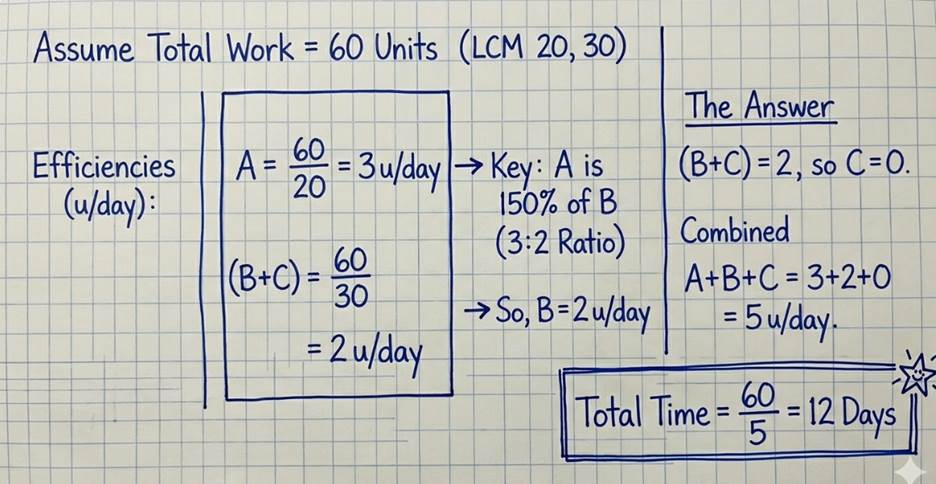
A is 50% more efficient than B. B and C together can complete a piece of work in 30 days, while A alone can complete it in 20 days. In how many days can A, B, and C together complete the work?

  • A.

    10 days

  • B.

    15 days

  • C.

    12 days

    ✓ Correct
  • D.

    13 days

  • E.

    9 days

Answer & Solution

Correct option is C


Information Given in the Question:
A is 50% more efficient than B
A alone completes work in 20 days
B + C completes work in 30 days
Concept/Formula Used in the Question:
Efficiency ∝ 1 / Time

Detailed Explanation:
Take total work = LCM of 20 and 30 = 60 units
Now,
A’s 1 day work = 60 / 20 = 3 units
A is 50% more efficient than B →
A : B = 3 : 2
So,
B’s 1 day work = 2 units
Now,
B + C complete work in 30 days →
(B + C) 1 day work = 60 / 30 = 2 units
So,
C’s work = (B + C) - B = 2 - 2 = 0
Now total work rate of A + B + C:
= 3 + 2 + 0 = 5 units/day
Time taken = Total work / total efficiency
= 60 / 5 = 12 days
Exam Hall Approach
Q6.

Pipe A can fill a tank in 6 hours, while Pipe B can fill it in 3 hours. The efficiency ratio of pipes A and B together to pipe C is 3:1. Find the time (in hours) taken by pipe C alone to fill the tank.

  • A.

    4

  • B.

    8

  • C.

    7

  • D.

    5

  • E.

    6

    ✓ Correct

Answer & Solution

Correct option is E


Information Given in the Question:
Pipe A fills tank in 6 hours
Pipe B fills tank in 3 hours
Efficiency ratio of (A + B) : C = 3 : 1
Concept/Formula Used in the Question:
Efficiency ∝ 1 / Time
Total efficiency of A + B = Sum of individual efficiencies
Detailed Explanation:
Efficiency of A = 1/6
Efficiency of B = 1/3
Efficiency of (A + B):
=16+13= \frac{1}{6} + \frac{1}{3}

=16+26=36=12= \frac{1}{6} + \frac{2}{6} = \frac{3}{6} = \frac{1}{2}

Given: (A+B):C=3:1\text{Given: }(A + B) : C = 3 : 1​​​

So, efficiency of C =13×efficiency of (A+B)\text{So, efficiency of C } = \frac{1}{3} \times \text{efficiency of } (A + B)
=13×12=16= \frac{1}{3} \times \frac{1}{2} = \frac{1}{6}​​​
Time taken by C = reciprocal of efficiency
= 6 hours
Exam Hall Approach
Q7.

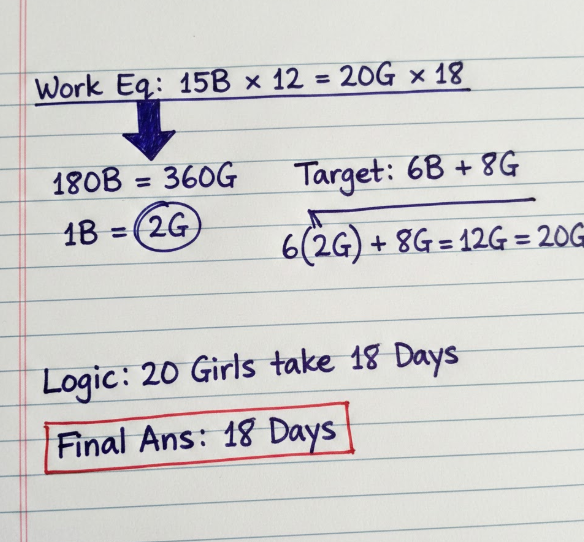
15 boys can complete a piece of work in 12 days, while 20 girls can complete the same work in 18 days. In how many days will 6 boys and 8 girls together complete the same work?

  • A.

    18

    ✓ Correct
  • B.

    12

  • C.

    15

  • D.

    20

  • E.

    22

Answer & Solution

Correct option is A

​​​
Information Given in the Question:
15 boys can complete a work in 12 days.
20 girls can complete the same work in 18 days.
Find time taken by (6 boys + 8 girls) together.
Concept/Formula Used in the Question:
Work = Rate × Time
Rate = Work / Time
If total work = 1 unit, then combined rate = sum of individual rates
Time = Total work / Combined rate
Detailed Explanation:
Let total work = 1 unit.
Rate of 15 boys = 1/12 work per day
=> Rate of 1 boy = (112\frac{1}{12}​) ÷ 15 = 1/180 work per day
Rate of 20 girls = 118\frac{1}{18}​ work per day
=> Rate of 1 girl = (118\frac{1}{18}​) ÷ 20 = 1/360 work per day
Rate of 6 boys = 6 × (1180\frac{1}{180}​)
= 6180\frac{6}{180}​ = 130\frac{1}{30}​work per day
Rate of 8 girls = 8 × 1360\frac{1}{360}
= 8360\frac{8}{360}​= 145\frac{1}{45}​ work per day
Combined rate of (6 boys + 8 girls) = 130+145\frac{1}{30} + \frac{1}{45}
Take LCM 90: =390+290\frac{3}{90} + \frac{2}{90}
=590=118\frac{5}{90} = \frac{1}{18}​ work per day
Time taken = 1 ÷ (118\frac{1}{18}​) = 18 days
Exam Hall Approach

Q8.

10 men and 15 women together can complete a work in 6 days. It takes 100 days for one man alone to complete the same work. How many days will be required for one woman alone to complete the same work?

  • A.

    125

  • B.

    150

  • C.

    200

  • D.

    225

    ✓ Correct
  • E.

    115

Answer & Solution

Correct option is D

Given
10 men and 15 women time = 6 days
1 man time = 100 days

Formula Used
Total Work = (Number of People) × Efficiency × Time

Solution
Let the efficiency of a man be M and a woman be W.
Total Work = (10M + 15W) × 6
Total Work = 1M × 100
Equating both:
(10M + 15W) × 6 = 100M
60M + 90W = 100M
90W = 40M
9W = 4M
M = 94W\frac{9}{4}W​​
Total work in terms of W = 100×(94W)100 × (\frac{9}{4}W)​ = 225W
Time for 1 woman = Total Work / Efficiency of 1 woman
Time =225WW \frac{225W}{W} ​= 225 days

Final Answer
So the correct answer is (d)

Q9.

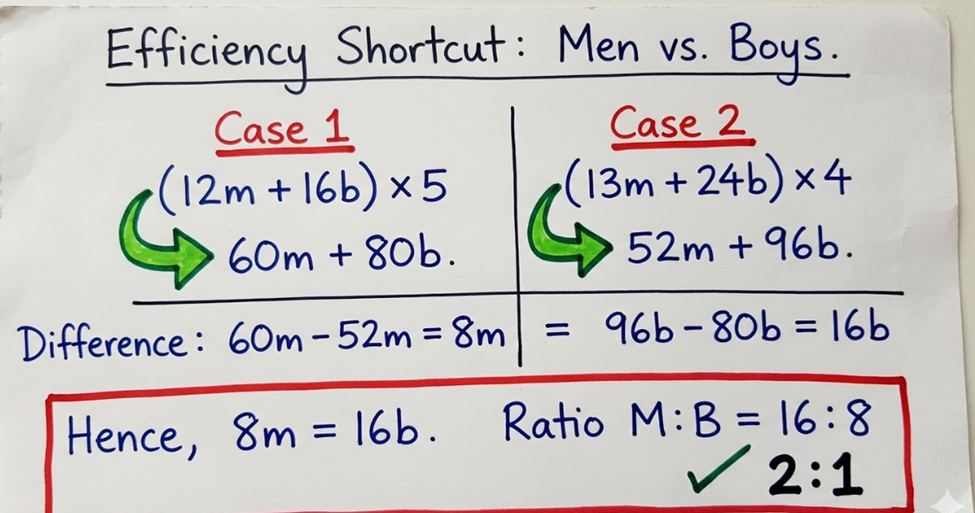
If 12 men and 16 boys can do a piece of work in 5 days; 13 men and 24 boys can do it in 4 days, then find the ratio of the daily work done by a man to that of a boy.

  • A.

    2 : 1

    ✓ Correct
  • B.

    3 : 1

  • C.

    3 : 2

  • D.

    5 : 4

  • E.

    1:5

Answer & Solution

Correct option is A

Given
12 men + 16 boys time = 5 days
13 men + 24 boys time = 4 days

Formula Used
Total Work = (M × D)

Solution
Let M be the efficiency of a man and B be the efficiency of a boy.
Total Work = (12M + 16B) × 5 = (13M + 24B) × 4
60M + 80B = 52M + 96B
60M - 52M = 96B - 80B
8M = 16B
MB=168=21\frac{M}{B} = \frac{16}{8} = \frac{2}{1}​​
The ratio is 2 : 1

Final Answer
So the correct answer is (a)

Exam Hall Approach

Q10.

A, B and C can do a piece of work in 11 days, 20 days and 55 days respectively, working alone. How soon can the work be done if A is assisted by B and C on alternate days?

  • A.

    7 days

  • B.

    8 days

    ✓ Correct
  • C.

    9 days

  • D.

    10 days

  • E.

    15 days

Answer & Solution

Correct option is B

Given
A's time = 11 days
B's time = 20 days
C's time = 55 days

Formula Used
Efficiency = Total Work / Time

Solution
Total work = {LCM}(11, 20, 55) = 220 units
Efficiency of A = 22011\frac{220}{11} ​= 20 units/day
Efficiency of B = 22020\frac{220}{20}​ = 11 units/day
Efficiency of C = 22055\frac{220}{55} ​= 4 units/day
Day 1: A + B work together
Efficiency = 20 + 11 = 31 units
Day 2: A + C work together
Efficiency = 20 + 4 = 24 units
Total work in 2 days = 31 + 24 = 55 units
Number of 2-day cycles required = 22055\frac{220}{55}​ = 4 cycles
Total time = 4 × 2 = 8 days

Final Answer
So the correct answer is (b)

Q11.

6 women can complete a piece of work in 10 days, whereas 10 children alone take 15 days to complete the same piece of work. How many days will 6 women and 10 children together take to complete the piece of work?

  • A.

    7

  • B.

    8

  • C.

    6

    ✓ Correct
  • D.

    4

  • E.

    None of these

Answer & Solution

Correct option is C

Given
Time taken by 6 women = 10 days
Time taken by 10 children = 15 days

Formula Used
1Total Time=1T1+1T2\frac{1}{Total\, Time} = \frac{1}{T_1} + \frac{1}{T_2}​​

Solution
Work done by 6 women in 1 day = 110\frac{1}{10}​​
Work done by 10 children in 1 day = 115\frac{1}{15}

Work done by (6 women + 10 children) in 1 day = 110+115\frac{1}{10} + \frac{1}{15}​​
LCM of 10 and 15 is 30.
Combined 1 day work = 3+230=530=16\frac{3 + 2}{30} = \frac{5}{30} = \frac{1}{6}​​
Total time taken = 6 days.

Final Answer
So the correct answer is (c)

Q12.

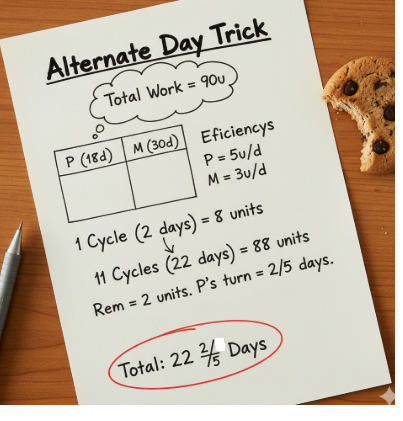
Priya and Monika working alone can complete a piece of work in 18 days and 30 days respectively. If they work alternate days starting with Priya, then find the number of day to complete the work?

  • A.

    10 (5/9) days

  • B.

    22 (2/5) days

    ✓ Correct
  • C.

    9 (5/9) days

  • D.

    12 (5/9) days

  • E.

    8 (5/9) days

Answer & Solution

Correct option is B

Given:

Priya  alone can complete a piece of work in 18 days

Monika alone can complete a piece of work in 30 days

Formula Used: 

Total work = Efficiency x Time

Explanation:

(Priya and Monika)’s 1 day work alternatively
=1/18+1/30=8/90
(Priya and Monika)’s 22 days work
=(8×11)/90=88/90
Remaining work=1 –88/90=1/45
∴1/45 work done by Priya = 2/5 days
Total time = 22 (2/5) days.

Exam Hall Method: 

Q13.

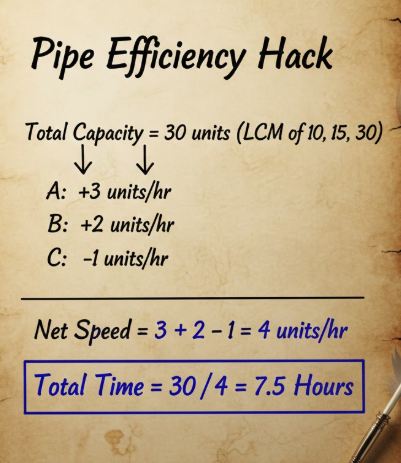
Pipe A can fill a tank in 10 hours, pipe B can fill it in 15 hours, and pipe C can empty it in 30 hours. If all pipes are opened together, find the time taken to fill the tank (in hours).

  • A.

    10

  • B.

    15

  • C.

    7.5

    ✓ Correct
  • D.

    3.5

  • E.

    6.5

Answer & Solution

Correct option is C

Given:A=10 hoursB=15 hoursC=30 hours (emptying)Concept Used:Net work rate of filling and emptying pipesFormula Used:Net rate=Filling rateEmptying rateSolution:Rate of A=110Rate of B=115Rate of C=130Net rate=110+115130=3+2130=430=215Time=12/15=152Final Answer:7.5\text{Given:}\\A = 10 \text{ hours}\\B = 15 \text{ hours}\\C = 30 \text{ hours (emptying)}\\[6pt]\text{Concept Used:}\\\text{Net work rate of filling and emptying pipes}\\[6pt]\text{Formula Used:}\\\text{Net rate} = \text{Filling rate} - \text{Emptying rate}\\[6pt]\text{Solution:}\\\text{Rate of A} = \frac{1}{10}\\\text{Rate of B} = \frac{1}{15}\\\text{Rate of C} = \frac{1}{30}\\[6pt]\text{Net rate}= \frac{1}{10} + \frac{1}{15} - \frac{1}{30}\\= \frac{3+2-1}{30}\\= \frac{4}{30}\\= \frac{2}{15}\\[6pt]\text{Time} = \frac{1}{2/15} = \frac{15}{2}\\[6pt]\text{Final Answer:}\\\boxed {7.5}​​
Exam Hall Approach

Q14.

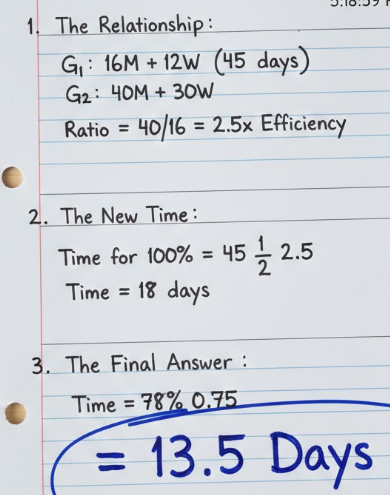
​16 men and 12 women together can construct a road in 45 days. It will take how much time for 40 men and 30 women together to construct 75% of the road?

  • A.

    15

  • B.

    13.5

    ✓ Correct
  • C.

    11.5

  • D.

    18

  • E.

    20.5

Answer & Solution

Correct option is B

Given:(16M+12W) complete work in 45 days(40M+30W) must complete 75% workConcept Used:Work and timeFormula Used:Work=Efficiency×TimeSolution:(16M+12W)×45=140M+30W16M+12W=10(4M+3W)4(4M+3W)=104=2.5Time for full work=452.5=18Time for 75%=18×34=13.5Final Answer:13.5 days\textbf{Given:}\\(16M + 12W) \text{ complete work in } 45 \text{ days}\\(40M + 30W) \text{ must complete } 75\% \text{ work}\\[6pt]\textbf{Concept Used:}\\\text{Work and time}\\[6pt]\textbf{Formula Used:}\\\text{Work} = \text{Efficiency} \times \text{Time}\\[6pt]\textbf{Solution:}\\(16M + 12W) \times 45 = 1\\\frac{40M + 30W}{16M + 12W}= \frac{10(4M + 3W)}{4(4M + 3W)}= \frac{10}{4}= 2.5\\\text{Time for full work} = \frac{45}{2.5} = 18\\\text{Time for } 75\% = 18 \times \frac{3}{4} = 13.5\\[6pt]\textbf{Final Answer:}\\\boxed{13.5 \text{ days}}

Exam Hall Method:

Q15.

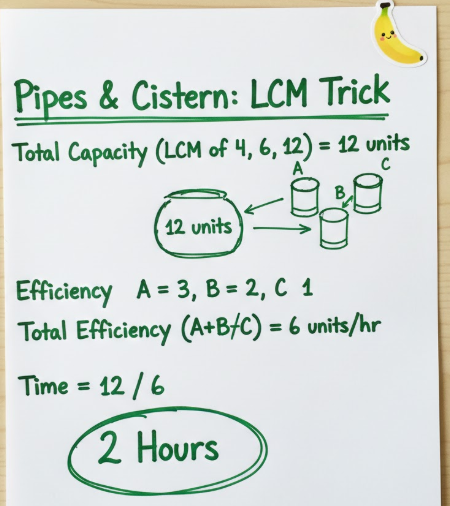
Three pipes A, B and C can fill a tank individually in 4 hours, 6 hours and 12 hours respectively. Find the time taken by all three pipes together to fill the tank (in hours).

  • A.

    2

    ✓ Correct
  • B.

    1.5

  • C.

    2.4

  • D.

    3

  • E.

    2.5

Answer & Solution

Correct option is A

Given:A=4, B=6, C=12Concept Used:Combined work using rates of pipesFormula Used:Rate=1TimeSolution:Rate of A=14Rate of B=16Rate of C=112Combined rate=14+16+112=3+2+112=612=12Time=11/2=2Final Answer:2 hours\text{Given:}\\A = 4,\;B = 6,\;C = 12\\[6pt]\text{Concept Used:}\\\text{Combined work using rates of pipes}\\[6pt]\text{Formula Used:}\\\text{Rate} = \frac{1}{\text{Time}}\\[6pt]\text{Solution:}\\\text{Rate of A} = \frac{1}{4}\\\text{Rate of B} = \frac{1}{6}\\\text{Rate of C} = \frac{1}{12}\\[6pt]\text{Combined rate}\\= \frac{1}{4} + \frac{1}{6} + \frac{1}{12}\\= \frac{3+2+1}{12}\\= \frac{6}{12}\\= \frac{1}{2}\\[6pt]\text{Time} = \frac{1}{1/2} = 2\\[6pt]\text{Final Answer:}\\\boxed{2 \text{ hours}}​​

Exam Hall Approach