Bank Exams Reasoning Questions with Detailed Solutions

Get Bank Exams Reasoning Questions to prepare for your upcoming exam. Solve the most expected questions and detailed solutions that can be asked in the exam.

Important Bank Exams Reasoning Questions

Q1.
Which of the following symbol replaces the question marks in the given series “A ≥ B = C ? D; E > F ? D ≥ L” such that ‘A ≥ F’ and ‘E > B’ are definitely true?
  • A.>
  • B.
  • C.<
  • D.=
    ✓ Correct
  • E.

Answer & Solution

Correct option is D

=
A ≥ B = C = D = F < E
A ≥ F True
E > B True
Q2.
Four of the five are alike in a certain way and form a group, find the odd one that does not follow the group.
  • A.KN
  • B.BE
  • C.VY
  • D.ZW
    ✓ Correct
  • E.RU

Answer & Solution

Correct option is D

ZW
KN K+3 N
BE B+3 E
VY V+3 Y
ZW Z-3 W
RU R+3 U
Q3.


  • A.Only conclusion II is true
  • B.Both conclusions I and II are true
  • C.Only conclusions I is true
  • D.Either conclusion I or II is true
  • E.Neither conclusion I nor II is true
    ✓ Correct

Answer & Solution

Correct option is E

Neither conclusion I nor II is true
Solution
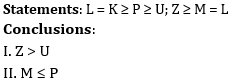
Given Statements: L = K ≥ P ≥ U; Z ≥ M = L
On combining the statements, we get
Z ≥ M = L = K ≥ P ≥ U
Conclusions:
I. Z > U: False (As, Z ≥ M = L = K ≥ P ≥ U, so, Z ≥ U)
II. M ≤ P: False (As, M = L = K ≥ P, so, M ≥ P)
Therefore, neither conclusion I nor II is true.
Q4.
How many pairs of letters are there in the word 'VERSATILE', which has as many letters between them in the word (both forward and backward) as in the English Alphabetical series?
  • A.Two
  • B.Three
    ✓ Correct
  • C.Four
  • D.Five
  • E.None of the above

Answer & Solution

Correct option is B

Three
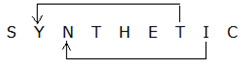
Given Word: 'VERSATILE'.
There are three pairs ('RS', 'AE', and 'SV') in the word, which has as many letters between them (both forward and backward) as in the English Alphabetical Series.
Hence, option b.
Q5.
If all the digits of the number '285393714' are written in increasing order from the left end, then what is the sum of third and eighth digit from the right end?
  • A.13
  • B.11
  • C.10
  • D.9
    ✓ Correct
  • E.7

Answer & Solution

Correct option is D

9
Solution
Given number: 285393714
After replacement, we get: 1 23345 789
The third digit from the right end is: 7
The eighth digit from the right end is: 2
So, the sum of third and eighth digit from the right end is: 7 + 2 = 9
Q6.
Statements:
A Few Rose is Red.
Only Red is Lily.
No Rose is Blue.
Conclusions:
I. No Lily is Rose.
II. Some Red not being Rose is a possibility.
  • A.Only conclusion II follows
  • B.Both conclusions I and II follow
  • C.Only conclusion I follows
    ✓ Correct
  • D.Neither conclusion I nor II follows
  • E.Either conclusion I or II follows

Answer & Solution

Correct option is C

Only conclusion I follows
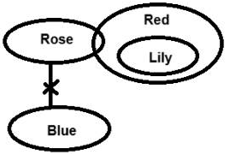
Following figure can be formed:

Conclusions:
I. No Lily is Rose: This definitely follows as only Red is Lily.
II. Some Red not being Rose is a possibility: This definitely doesn't follow as only Red is Lily, so, some Red can never be Rose, which is definite.
From the above figure, only conclusion I follows.
Q7.
If four-letter meaningful word can be formed by using the 4th, 5th, 7th and 13th letters of the word “RESPONSIBILITIES”, and then which is the third letter from the left end of the newly formed word? Mark X as your answer, if no meaningful word can be formed. Mark Z, if more than one word is formed.
  • A.S
  • B.O
  • C.T
  • D.X
  • E.Z
    ✓ Correct

Answer & Solution

Correct option is E

Z
Solution
Answer: E
The letters are P, O, S and T. So the newly formed meaningful words are POST, STOP.
Q8.


  • A.None
  • B.Two
    ✓ Correct
  • C.Three
  • D.One
  • E.More than three

Answer & Solution

Correct option is B

Two
Solution
Answer: B

Q9.
In the given below statement is followed by two conclusions choose the one which definitely follows disregarding the commonly known facts.
Statement
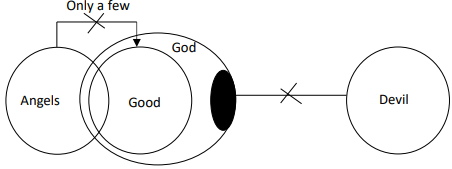
Only a few Angels is Good
All Good are God
Some God is not Devil
Conclusion:
I) Some Angels are Devil is a possibility
II) All God is Angel is a possibility
  • A.Only I follows
  • B.Only II follows
  • C.Either I or II follows
  • D.Neither I nor II follows
  • E.Both I and II follows
    ✓ Correct

Answer & Solution

Correct option is E


Both I and II follows
Explanation:

I) Some Angels are Devil is a possibility→True
II) All God is Angel is a possibility→True
Hence Both I and II follows.
Q10.
Which of the following symbols should replace the question mark (?) in the given expression in order to make the expressions ‘P > A’ as well as ‘T < L’ definitely true?
P > L ? A ≥ N = T
  • A.
  • B.>
    ✓ Correct
  • C.<
  • D.
  • E.Either ≥ or >

Answer & Solution

Correct option is B

>
1) ≤ → P > L ≤ A ≥ N = T (P > A is False)
2) > → P > L > A ≥ N = T (P > A and L > T is True)
3) < → P > L < A ≥ N = T (P > A is False)
4) ≥ → P > L ≥ A ≥ N = T (L > T is not defenitely true)
5) Either ≥ or >
Therefore, > will make the expression P > A and T < L definitely true.
Q11.
Which of the following symbols should be placed in the blank spaces respectively (in the same order from left to right in order to complete the given expression in such a manner that makes the expressions ‘U ≥ E’ as well as ‘C = L’ definitely true?
U__N__C__L__E
  • A.=, =, ≥, ≥
  • B.>, ≥, =, >
  • C.=, =, =, ≥
    ✓ Correct
  • D.>, =, <, ≥
  • E.None of these

Answer & Solution

Correct option is C

=, =, =, ≥
1) =, =, ≥, ≥
U = N = C ≥ L ≥ E
U ≥ E → possibly true (as U ≥ L ≥ E)
C = L → false (C ≥ L)
2) >, ≥, =, >U > N ≥ C = L > E
U ≥ E → false (as U > E)
C = L → true (C = L)
3) =, =, =, ≥
U = N = C = L ≥ E
U ≥ E → true (U = L ≥ E)
C = L → true (C = L)
4) >, =, <, ≥
U > N = C < L ≥ E
U ≥ E → false (the relationship between U and E cannot be defined)
C = L → false (C < L)
So =, =, =, ≥ symbols complete the given expression in such a manner that makes the expressions ‘U ≥ E’ as well as ‘C = L’ definitely true
Hence, option ‘ =, =, =, ≥ ’ is the correct option.
Q12.
In which of the given expressions does the expression M < T and B > K definitely hold true?
  • A.S < T; A ≥ B > P ≥ T > R; K < M < S
    ✓ Correct
  • B.S < T; A ≥ B > P ≥ T > R; K < M > S
  • C.S < T; A ≥ B > P < T > R; K < M < S
  • D.S > T; A ≥ B > P < T > R; K < M < S
  • E.None of the above.

Answer & Solution

Correct option is A

S < T; A ≥ B > P ≥ T > R; K < M < S
Explanation:
From option a, K < M < S < T ≤ P < B ≤ A
From option b, K < M > S < T ≤ P < B ≤ A
From option c, K < M < S < T > P < B ≤ A
From option d, K < M < S > T > P < B ≤ A
Q13.
In which of the given expressions does the expression D > M and B < F definitely hold true?
  • A.Y ≤ M < C; D ≤ E < F; C < B ≤ A > D
  • B.Y ≤ M ≥ C; D ≤ E < F; C > B ≤ A < D
  • C.Y > M < C; D > E < F; C < B ≤ A < D
  • D.Y ≤ M < C; D ≤ E < F; C < B ≤ A < D
    ✓ Correct
  • E.None of the above.

Answer & Solution

Correct option is D

Y ≤ M < C; D ≤ E < F; C < B ≤ A < D
Explanation:
From option a, Y ≤ M < C < B ≤ A > D ≤ E < F
From option b, Y ≤ M ≥ C > B ≤ A < D ≤ E < F
From option c, Y > M < C < B ≤ A < D > E < F
From option d, Y ≤ M < C < B ≤ A < D ≤ E < F
Q14.

Which of the following expression(s) follow if the given expression ‘M ≥ O > R = X > I ≤ B ≤ A’ is definitely true?
A. B ≥ X
B. I < M
C. A ≥ I
D. B ≤ X
E. R > A

  • A.

    Only B follows.

  • B.

    Only either A or D follows.

  • C.

    Only either A or D and B and C follow

    ✓ Correct
  • D.

    Only C follows

  • E.

    Only B and C follow.

Answer & Solution

Correct option is C

Only either A or D and B and C follow.
Given, M ≥ O > R = X > I ≤ B ≤ A, Now we will check each relation:
A) B ≥ X → False (as X > I ≤ B → thus a clear relation between B and X cannot be determined).
B) I < M → True (as M ≥ O > R = X > I).
C) A ≥ I → True (as I ≤ B ≤ A).
D) B ≤ X → False (as X > I ≤ B → thus a clear relation between B and X cannot be determined).
E) R > A → False (as R = X > I ≤ B ≤ A → thus a clear relation between R and A cannot be determined).
Hence, only either A or D and B and C follows.

Q15.
What should come in the place of question mark (?) in the given expression if S > B and U > D are definitely true?
B > C ≥ D; U > S ≥ T; B ≤ A ? T
  • A.< or ≤
  • B.> or ≥
  • C.Only >
  • D.Only <
    ✓ Correct
  • E.None of the above

Answer & Solution

Correct option is D

Only <