

hamburger menu
All Coursesall course arrow
adda247
reward-icon
adda247
    arrow
    arrow
    arrow
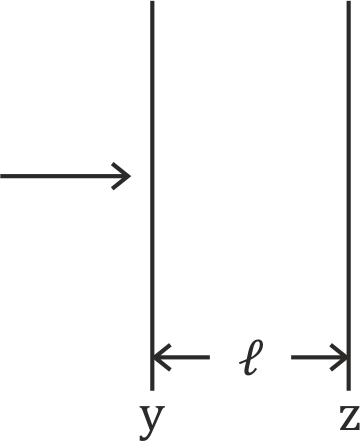
    Y and Z are two partially reflecting glass sheets, a distance lll​ apart in air. White light falls normally on Y. The light emerging from Z is an
    Question

    Y and Z are two partially reflecting glass sheets, a distance ll apart in air. White light falls normally on Y. The light emerging from Z is analysed by a spectrometer. A dark band is observed in the spectrometer at a wavelength. The distance ll must be equal to:

    A.

    nλ/2

    B.

    (n+1/2)λ/2

    C.

    (n+1/4)λ/2

    D.

    (n+1/2)λ

    Correct option is B

    When light undergoes interference due to partially reflecting surfaces, dark fringes are observed when destructive interference occurs. The path difference (Δ) for destructive interference is given by the equation:

    Δ = (2l + 1)λ/2

    Where l is the distance between the two surfaces, and λ is the wavelength of the light.

    For destructive interference to occur, the path difference must be an odd multiple of λ/2. Hence, the path difference formula is given as:

    Δ = (2n + 1) λ/2, where n = 0, 1, 2, ...

    So, the distance 'l' must be equal to:

    l = (n + 1/2) λ/2.

    test-prime-package

    Access ‘AAI JE ATC’ Mock Tests with

    • 60000+ Mocks and Previous Year Papers
    • Unlimited Re-Attempts
    • Personalised Report Card
    • 500% Refund on Final Selection
    • Largest Community
    students-icon
    354k+ students have already unlocked exclusive benefits with Test Prime!
    test-prime-package

    Access ‘AAI JE ATC’ Mock Tests with

    • 60000+ Mocks and Previous Year Papers
    • Unlimited Re-Attempts
    • Personalised Report Card
    • 500% Refund on Final Selection
    • Largest Community
    students-icon
    354k+ students have already unlocked exclusive benefits with Test Prime!
    Our Plans
    Monthsup-arrow
