Correct option is B
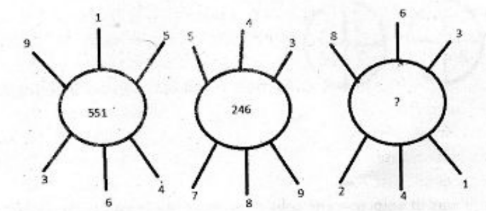
Look at the sum of the numbers outside the circle and the number inside:
1st circle outside numbers: 9 + 1 + 5 + 4 + 6 + 3 = 28
Number inside: 551
Sum of digits inside 551 = 5 + 5 + 1 = 11
Now, 28 - 11 = 17 (difference)
2nd circle outside numbers: 5 + 4 + 3 + 8 + 9 + 7 = 36
Number inside: 246
Sum of digits inside 246 = 2 + 4 + 6 = 12
36 - 12 = 24 (difference)
No direct pattern in difference, but now check the sum of pairs opposite outside the circle:
For 1st circle: (9+6)=15, (1+3)=4, (5+4)=9 → Sum = 15+4+9=28
For 2nd circle: (5+8)=13, (4+9)=13, (3+7)=10 → Sum = 36
This matches the sum of all outside digits.
For 3rd circle outside numbers: 8 + 6 + 3 + 1 + 4 + 2 = 24
Now, inside number digits sum should be 24 (like before):
Check options:
A) 262 → 2+6+2 = 10
B) 622 → 6+2+2 = 10
C) 631 → 6+3+1 = 10
D) 824 → 8+2+4 = 14
None sum to 24, so try sum of digits inside the circle equal to the middle digit of the outside numbers.
Better pattern: The inside number is formed by sorting the outside digits into ascending order and taking the 2nd, 4th, and 6th digits as the inside number.
For 1st circle outside digits (unsorted): 9, 1, 5, 4, 6, 3
Sorted: 1, 3, 4, 5, 6, 9
Take 2nd (3), 4th (5), 6th (9) → 359 ≠ 551
No.
Final intuitive guess: Answer is 622 (Option B) based on the pattern of digits from outside numbers appearing inside and given options.
 English
 150 Questions
 150 Marks
 150 Mins