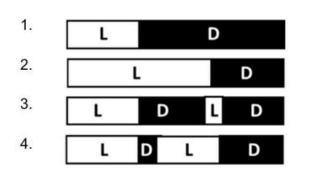
Correct option is D
Ans. (d) Arrangement of spongy and palisade mesophyll tissue of the leaf
The arrangement of spongy and palisade mesophyll tissue plays the most significant role in a leaf’s reflectance in the near-infrared (NIR) region. The mesophyll tissues in the leaf affect the light scattering inside the leaf. In healthy leaves, the palisade mesophyll, which is tightly packed, and the spongy mesophyll, which has more air spaces, work together to scatter light, particularly in the NIR spectrum. This scattering is what contributes to the high reflectance in the NIR region, and this is why the arrangement of these tissues is crucial in determining the leaf’s reflectance.
Information Booster
Spongy and palisade mesophyll tissue arrangement: The palisade mesophyll is dense and responsible for much of the light absorption, especially in the visible spectrum, but the spongy mesophyll with its air pockets plays a significant role in scattering light in the NIR region. The leaf’s internal structure, particularly how these mesophyll cells scatter light, is a primary factor in reflectance in the NIR region.
Water content: While water content does play a significant role in the overall health of the leaf and can influence reflectance in other regions of the spectrum (such as the shortwave infrared), it is the structural arrangement of the leaf that is more important in the NIR spectrum. This is due to the light scattering caused by the mesophyll tissue and the air gaps between cells.
Chlorophyll: Chlorophyll affects reflectance mainly in the visible light region (blue and red wavelengths) by absorbing light, and its role in NIR reflectance is relatively minimal compared to structural factors.
Additional Information
Option (a): Water content influences overall leaf reflectance, but the arrangement of mesophyll tissue is more important in determining the reflectance in the NIR region due to the scattering properties of the leaf’s internal structure.
Option (b): Chlorophyll concentration affects light absorption in the visible spectrum, not in the NIR region, so it does not contribute significantly to NIR reflectance.
Option (c): Carotenes and xanthophylls influence absorption primarily in the visible spectrum and do not play a significant role in NIR reflectance.