Correct option is B
Analysis of Options:
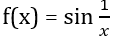
Option (a): f(x) = sin(1/x)
- As x→0+x \to 0^+x→00+, 1/x→∞1/x \to \infty1/x→∞, causing the oscillations of sin(1/x)\sin(1/x)sin(1/x) to become arbitrarily fast.
- Uniform continuity fails because the function does not maintain a uniform "rate of change" as xxx approaches 000.
- Not uniformly continuous.
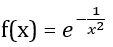
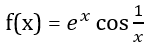
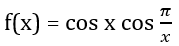
(b)x→0+lime−x21=0&x→1−lime−x21=e−1=e1So e−x21 is Uniformly Continuous in (0,1) (c)∵x→0+limexcosx1 does not exist, so excosx1 is not Uniformly Continuous in (0,1) (d)∵x→0+limcosxcosxπ does not exist, so cosxcosxπ is not Uniformly Continuous in (0,1)