






Correct option is A
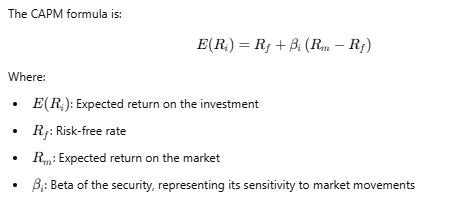
The Capital Asset Pricing Model (CAPM) is highly suitable for risk-return analysis in financial decision-making. It is a financial model that relates the expected return of an investment to its risk as measured by its beta (β), which shows how the asset's return reacts to the movements of the market.
The CAPM helps investors and financial managers make informed decisions by quantifying the trade-off between risk and expected return. It determines whether a particular investment offers a return commensurate with its level of risk.
Information Booster
Why CAPM is Suitable for Risk-Return Analysis:
1. Risk-Return Relationship: CAPM explicitly establishes a linear relationship between the systematic risk (market-related risk) and the expected return of an asset.
2. Portfolio Management: CAPM assists in identifying whether a security is overvalued or undervalued based on its expected return versus its risk (beta).
3. Decision-Making Tool: Investors and financial managers use CAPM to evaluate investment opportunities and decide whether to add a specific asset to their portfolios.
4. Practical Application: CAPM is widely used in cost of equity calculation in capital budgeting and valuation decisions.
Additional Knowledge
Incorrect Options Explained:
1. SWOT analysis (Option b): SWOT analysis (Strengths, Weaknesses, Opportunities, Threats) is a strategic planning tool. It helps identify internal and external factors affecting an organization. However, it is not a quantitative tool for analyzing financial risk and return, making it unsuitable for financial decisions involving investments.
2. Capital gearing (Option c): Capital gearing refers to the ratio of debt to equity in a company's capital structure. While it highlights financial leverage and its implications for financial stability, it does not specifically address the relationship between risk and return.
3. EVA analysis (Option d): EVA (Economic Value Added) is a performance measure that assesses whether a company's operations generate value above its cost of capital. While it is useful for measuring profitability and value creation, it does not focus on analyzing the risk-return trade-off in financial decision-making.
 English
 10 Questions
 20 Marks
 12 Mins


