






Correct option is D
The correct answer is (d) Liquid state changes to gaseous state
Explanation:
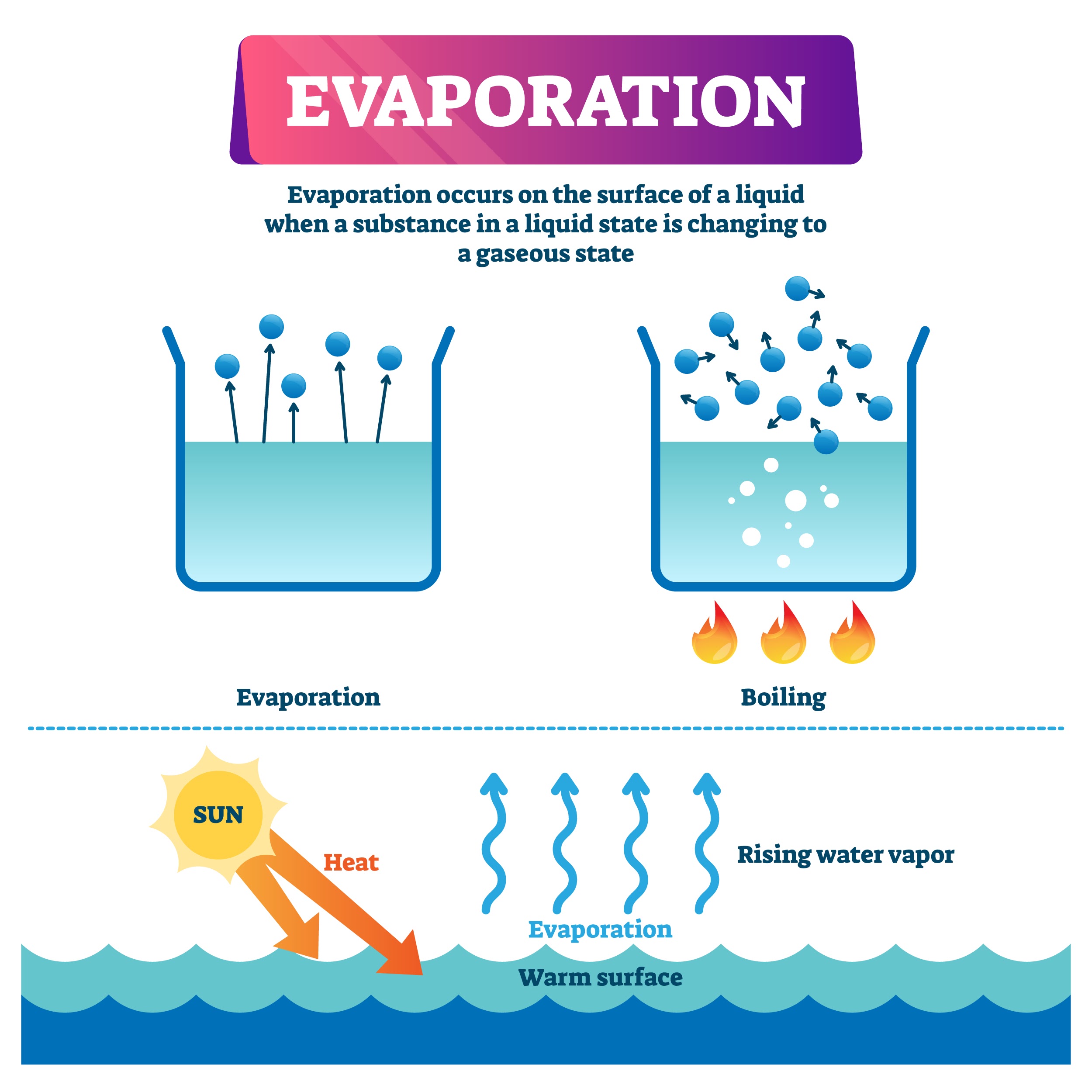
Evaporation is a type of vaporization that occurs on the surface of a liquid as it changes into the gas phase.
Unlike boiling, evaporation is a surface phenomenon and can occur at temperatures below the boiling point of the liquid.
Particles at the surface of the liquid gain enough kinetic energy to overcome the forces of attraction from other particles and escape into the air as vapor (gas).
According to NCERT Class 9 Science, evaporation causes cooling because the particles absorb energy (latent heat of vaporization) from the surroundings to change their state.
Information Booster:
Factors affecting evaporation:
Surface Area: Increasing the surface area increases the rate of evaporation (e.g., spreading clothes to dry).
Temperature: Higher temperatures provide more kinetic energy, speeding up the process.
Humidity: Higher humidity in the air decreases the rate of evaporation.
Wind Speed: Increased wind speed moves vapor particles away, increasing the rate.
Additional Knowledge:Fluid state changes to solid state (Option a) * This process is known as Freezing or Solidification (e.g., water turning into ice).
Gaseous state changes to a fluid state (Option b) * This process is known as Condensation (e.g., dew forming on grass or water droplets on a cold glass).
Solid state changes to liquid state (Option c) * This process is known as Melting or Fusion (e.g., ice melting into water).
Direct transition from solid to gas: * This is called Sublimation (e.g., camphor or dry ice disappearing without becoming liquid).
 English
 100 Questions
 100 Marks
 90 Mins


