Correct option is B
The correct answer is (b) Photovoltaic effect.
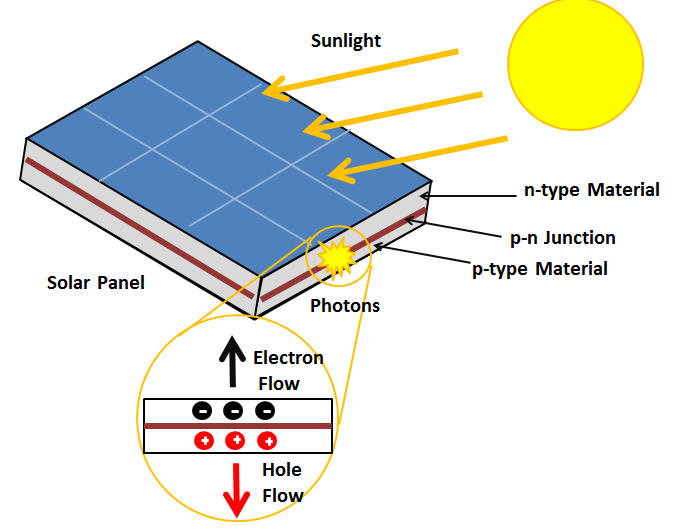
· Photovoltaic effect: This is the principle behind solar power systems. It involves the conversion of light into electricity using semiconducting materials that exhibit the photovoltaic effect. When sunlight hits a photovoltaic (PV) cell, it excites electrons, creating an electric current.
· Solar panels are made up of many PV cells, typically composed of silicon, that harness sunlight and convert it into electrical energy, which can be used to power homes, businesses, and other applications.
Information Booster:
· Photoelectric effect: This effect involves the emission of electrons from a material when it is exposed to light. While related to the photovoltaic effect, it is not the primary principle used in solar power systems for generating electricity.
· Photokinetic effect: This term is not commonly associated with solar power or the generation of electricity from sunlight. It generally refers to the movement induced by light, but it is not relevant to solar power systems.
· Photosynthesis effect: Photosynthesis is the process by which green plants and some other organisms use sunlight to synthesize foods with the help of chlorophyll. It is not related to the generation of electricity in solar power systems.
 English
 100 Questions
 100 Marks
 90 Mins