arrow
arrow
arrow
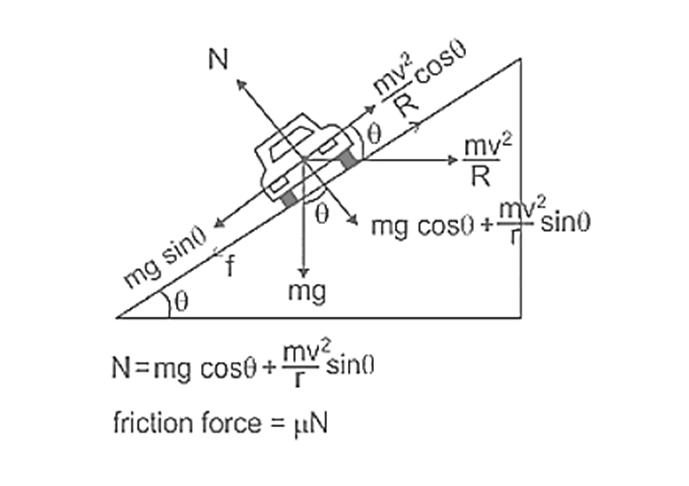
Which of the following is the correct expression for maximum possible speed of a caron a banked road?
Question

Which of the following is the correct expression for maximum possible speed of a caron a banked road?

A.

vmax=μsRgv_{\max }=\sqrt{\mu_s R g}​​

B.

vmax=(Rgμs+tanθ1μstanθ)v_{\max }=\left(R g \frac{\mu_s+\tan \theta}{1-\mu_s \tan \theta}\right)​​

C.

vmax=(Rgμs+tanθ1μstanθ)v_{\max }=\left(R g \frac{\sqrt{\mu_s+\tan \theta}}{\sqrt{1-\mu_s \tan \theta}}\right)​​

D.

vmax=(Rgμs+tanθ1μstanθ)1/2v_{\max }=\left(R g \frac{\mu_s+\tan \theta}{1-\mu_s \tan \theta}\right)^{1 / 2}​​

Correct option is D

​​The maximum permissible velocity for a car on a banked curve depends on the radius of the curve, the coefficient of friction between the tires and the road, and the angle of banking. The maximum speed without skidding is derived from balancing the forces of friction and the centripetal force required for the circular motion.

The general formula for the maximum permissible velocity vmax is:vmax=Rg(μs+tanθ)1μstanθWhere: R is the radius of the curve, g is the acceleration due to gravity, μs is the coefficient of static friction between the tires and the road, θ is the banking angle of the road.If the coefficient of friction μs=0 (i.e., the road is perfectly smooth), the maximum speed is:vmax=Rgtanθ\text{The general formula for the maximum permissible velocity } v_{\text{max}} \text{ is:} \\v_{\text{max}} = \sqrt{\frac{Rg \left( \mu_s + \tan \theta \right)}{1 - \mu_s \tan \theta}} \\\text{Where:} \\\bullet \, R \text{ is the radius of the curve,} \\\bullet \, g \text{ is the acceleration due to gravity,} \\\bullet \, \mu_s \text{ is the coefficient of static friction between the tires and the road,} \\\bullet \, \theta \text{ is the banking angle of the road.} \\\text{If the coefficient of friction } \mu_s = 0 \, \text{(i.e., the road is perfectly smooth), the maximum speed is:} \\v_{\text{max}} = \sqrt{Rg \tan \theta}

The formula for the maximum speed involves the banking angle θ, the radius of the curve R, and the coefficient of friction μs.Conclusion:The correct expression for the maximum speed of a car on a banked road is:vmax=Rg(μs+tanθ)1μstanθThis corresponds to Option D from the available choices.\text{The formula for the maximum speed involves the banking angle } \theta, \text{ the radius of the curve } R, \text{ and the coefficient of friction } \mu_s. \\\textbf{Conclusion:} \\\text{The correct expression for the maximum speed of a car on a banked road is:} \\v_{\text{max}} = \sqrt{\frac{Rg \left( \mu_s + \tan \theta \right)}{1 - \mu_s \tan \theta}} \\\text{This corresponds to Option D from the available choices.}​​

Similar Questions

test-prime-package

Access ‘AAI JE ATC’ Mock Tests with

  • 60000+ Mocks and Previous Year Papers
  • Unlimited Re-Attempts
  • Personalised Report Card
  • 500% Refund on Final Selection
  • Largest Community
students-icon
354k+ students have already unlocked exclusive benefits with Test Prime!
test-prime-package

Access ‘AAI JE ATC’ Mock Tests with

  • 60000+ Mocks and Previous Year Papers
  • Unlimited Re-Attempts
  • Personalised Report Card
  • 500% Refund on Final Selection
  • Largest Community
students-icon
354k+ students have already unlocked exclusive benefits with Test Prime!
Our Plans
Monthsup-arrow