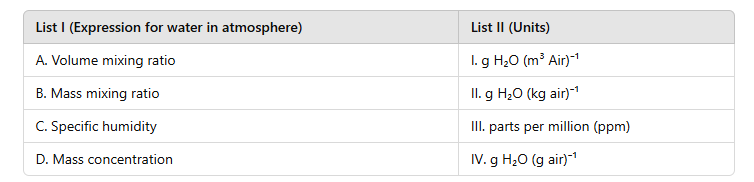
Correct option is B
(A) Potential temperature is a conserved quantity for an air parcel under adiabatic conditions.
True. As we discussed earlier, potential temperature is a quantity that remains constant when an air parcel moves adiabatically (without heat exchange). Under adiabatic conditions, the potential temperature of an air parcel remains unchanged, which is why it is considered a conserved quantity.
(B) The air parcel temperature becomes equal to the dew point temperature at the lifting condensation level.
True. As an air parcel rises, it cools down due to expansion (adiabatic cooling). The temperature at which the air parcel reaches saturation is called the lifting condensation level (LCL). At this level, the air parcel's temperature equals its dew point temperature, meaning it has cooled enough for condensation to begin and the water vapor starts to condense into liquid water. This process leads to cloud formation.
(C) The saturation vapor pressure over pure water increases linearly with the temperature of water.
False. The saturation vapor pressure of water does not increase linearly with temperature. It actually increases exponentially as temperature rises. The relationship is governed by the Clausius-Clapeyron equation, which shows that for each increase in temperature, the saturation vapor pressure rises sharply (exponentially), not in a straight line.
(D) The magnitude of the saturated adiabatic lapse rate is always greater than that of the dry adiabatic lapse rate.
False. The saturated adiabatic lapse rate (SALR) is smaller than the dry adiabatic lapse rate (DALR). This is because when the air parcel reaches saturation (100% relative humidity), the release of latent heat during condensation offsets the cooling process, causing the air parcel to cool at a slower rate than dry air. Therefore, the magnitude of the SALR is smaller than the DALR.
 English
 10 Questions
 20 Marks
 12 Mins