






Correct option is A
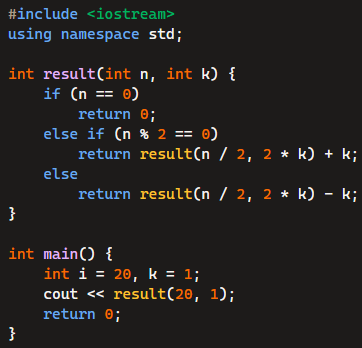
Let’s break down the recursive calls for the given input result(20, 1) step by step:
1. First call: result(20, 1)
· n = 20 (even): Call result(10, 2) + 1.
2. Second call: result(10, 2)
· n = 10 (even): Call result(5, 4) + 2.
3. Third call: result(5, 4)
· n = 5 (odd): Call result(2, 8) - 4.
4. Fourth call: result(2, 8)
· n = 2 (even): Call result(1, 16) + 8.
5. Fifth call: result(1, 16)
· n = 1 (odd): Call result(0, 32) - 16.
6. Base case: result(0, 32)
· n = 0: Return 0.
Now, let’s calculate the returned values step by step:
· result(0, 32) = 0.
· result(1, 16) = 0 - 16 = -16.
· result(2, 8) = -16 + 8 = -8.
· result(5, 4) = -8 - 4 = -12.
· result(10, 2) = -12 + 2 = -10.
· result(20, 1) = -10 + 1 = -9.
Thus, the final output is -9.
Important Key Points:
1. Base case: The recursion stops when n == 0, returning 0.
2. Even case (n % 2 == 0): Adds k to the result of the recursive call.
3. Odd case (n % 2 != 0): Subtracts k from the result of the recursive call.
4. The value of k doubles with each recursive step, significantly affecting the result.
Knowledge Booster:
· 10: This would occur if incorrect calculations were made in the addition/subtraction logic during recursion.
· -7: Represents a logical error if one subtraction step is skipped.
· -5: Results from a miscalculation in intermediate recursive steps.
· 9: Would appear if all additions were performed incorrectly, ignoring the subtraction logic.
 English
 100 Questions
 100 Marks
 60 Mins


